Toyota Hiace 4WD in Tanzania: Off-Road Capability, Features & Buying Guide
Toyota Hiace 4WD in Tanzania: Off-Road Capability, Features & Buying Guide
Read Our Blogs today and Learn More
Loading ...
Frequently Asked Questions (FAQs)
Yes. Right-hand-drive vehicles are permitted and there's no outright age ban on used imports from Japan. Age affects cost rather than eligibility: vehicles older than 8 years attract additional excise. Confirm current requirements on the import rules page before you commit to a purchase.
The 1GD-FTV's 2,754 cc puts it in the 10% excise band for engines above 2,000 cc. A sub-2,000cc engine sits at 5%, and anything up to 1,000 cc pays 0%. That gap compounds through the rest of the calculation, so use the vehicle page's landed cost estimate for a real figure.
On established circuits, yes. Graded murram, dry bush tracks and light sand are well within the AWD system's range, and it manages them without driver input. It is not suited to deep mud, waterlogged black cotton soil or sustained rocky ground. Operators running hard wet-season routes should look at a Land Cruiser 70 or Prado.
The 2018 to 2021 window is the practical choice. Those units clear the 8-year age charge, carry the 1GD-FTV diesel in facelift specification, and generally sit in a more accessible price band than 2023 or 2024 stock. A 2017 still works mechanically but picks up the age excise, so budget for it.
No. No warranty of any kind is offered on imported vehicles. What you get instead is full pre-shipment documentation: the official Japanese auction sheet and the in-house inspector report, both visible before payment, plus EAA inspection. Condition is confirmed while the van is still in Japan.
I am a Turkish-Australian automotive writer with a passion for hybrid vehicles and rugged 4WD adventures. My writing combines detailed technical insights with a love for outdoor exploration and Aussie driving culture. Having guest posted for leading automotive sites, my mission is to educate and inspire drivers considering greener and tougher vehicle options.
Published Date
August 21, 2026
An NGO moving eight staff to a field site 400 km from Dar es Salaam has an awkward problem. A Land Cruiser 70 has the grip but not the seats. A 2WD Hiace has the seats but gets stuck on wet murram in April. The 4WD Hiace sits precisely in that gap: high capacity, light off-road grip, and a diesel that will run all day on a gravel highway.
That makes it a specific tool: NGOs, rural safari operators, and upcountry fleet managers get real value from it, while Dar es Salaam commuters mostly do not. This guide covers what the drivetrain actually is (it is not what most listings imply), the full engine specification, where the van stops being capable, what the 2.8-litre diesel does to your duty bill, and which model years to target. No hype, and no pretending it's a Prado.
📋 Toyota Hiace 4WD in Tanzania, Key Facts
The Hiace "4WD" is a full-time AWD system with no low range and no 2H/4H/4L selector (Rising Rides, 2025). Graded murram and light sand, yes. Deep black cotton soil in the rains, no.
The 1GD-FTV (Toyota's 2.8-litre GD-series common-rail diesel) displaces 2,754 cc (TCV JDM spec sheet), which puts it in the 10% excise duty tier for engines above 2,000 cc.
Vehicles older than 8 years attract an extra excise charge. Under the Finance Act 2026 (Tanzania Revenue Authority, effective July 2026), the rate for non-utility vehicles is 18% for those aged 8–10 years and 35% for those aged 10–20 years; check Carbarn's import rules page for the current figures. In 2026 that means 2017 and earlier are affected.
4WD variants are rare in JDM auction stock. Most Hiace units on the market are 2WD, so confirm the drivetrain on the auction sheet before you commit.
The listed USD price covers the vehicle, shipping and inspection only. Duty, VAT and clearance are separate.
How Does the Hiace 4WD Compare to 2WD on Tanzania Roads?
The difference is narrower than the badge suggests, and it matters on maybe 10% of your route. Toyota's H200-series 4WD is a full-time all-wheel-drive system that splits torque automatically (Rising Rides, 2025). It buys you traction on damp gravel and loose surfaces, not the ability to climb rocks.
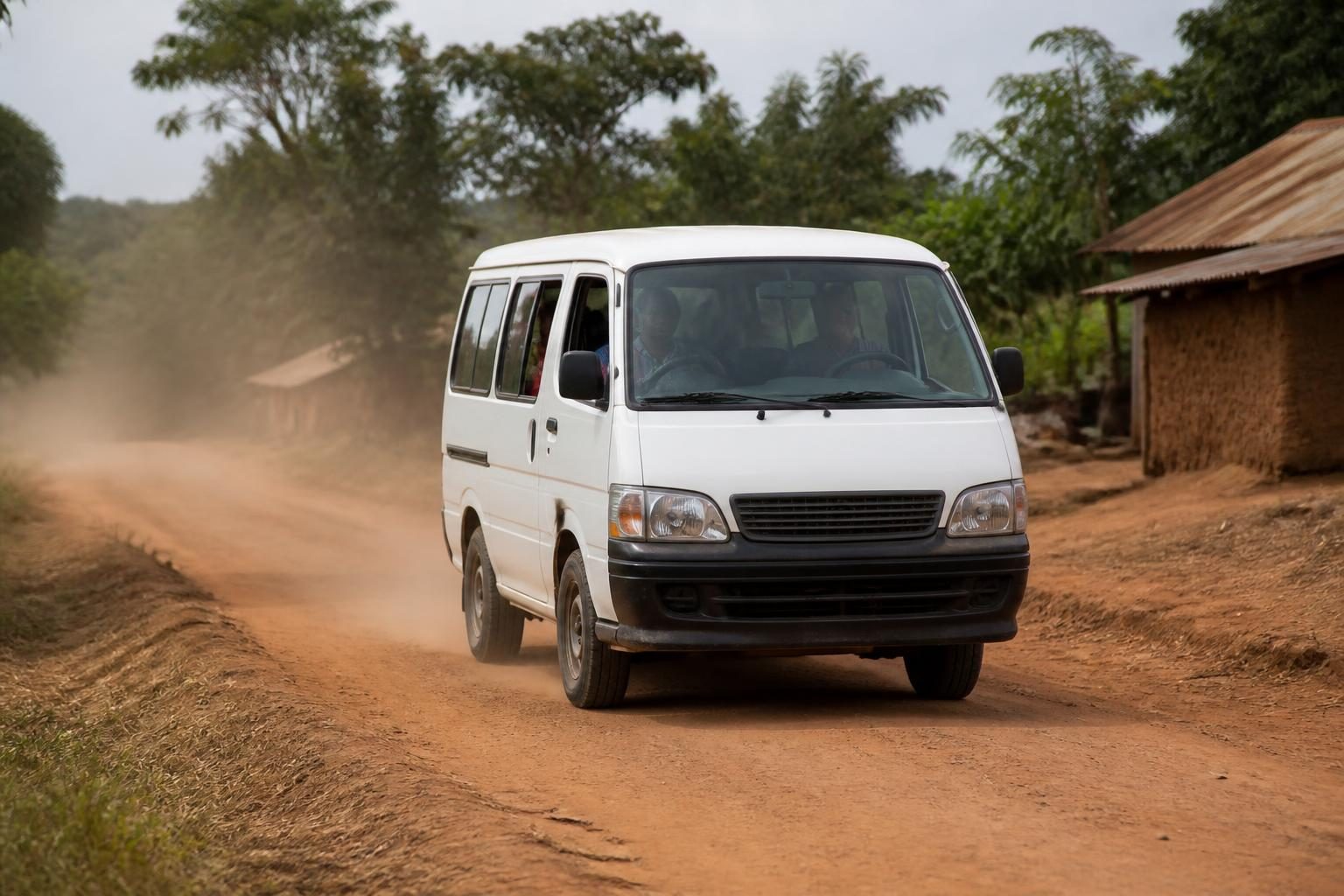
A white minibus travels along a dusty rural dirt road.
Where the 2WD Falls Short
A rear-wheel-drive Hiace is fine on tarmac and fine on dry graded dirt. It gets awkward in three specific places: the soft shoulder when you pull over on wet gravel, loose murram on an incline where the rear axle spins under load, and shallow seasonal clay crossings between field sites. Loaded with eight people and kit, that rear axle has weight on it but very little grip.
What 4WD Adds, and What It Doesn't
The real benefit is that you don't have to do anything — there's no lever to pull and no hub to lock. Torque redistributes as wheels lose grip, so a driver who isn't an off-road specialist stays moving on a damp gravel climb.
What you don't get: low-range gearing, a driver-selectable transfer case, or a locking differential. It's closer to a Kluger AWD than a Prado 4WD. That isn't a fault; it's the right amount of hardware for the roads this van actually drives.
Buyers searching for a Toyota Hiace 4x4 in Tanzania should know this is an AWD system, not a traditional 4x4 with a transfer case or low range — and that's fine for most of the routes where it's used.
4xoverland runs a factory Hiace AWD system through real off-road conditions, which is useful context before you buy.
Who Should Skip the 4WD Entirely
If your vehicle lives in Dar es Salaam and occasionally runs to Morogoro on tarmac, buy the 2WD. A sub-2,000cc petrol Hiace sits in the 5% excise band instead of 10%, so you save on the duty bill twice over. The 4WD premium only pays back on roads with genuine traction problems.
What Does the 1GD-FTV 2.8 Diesel Offer for Tanzania Buyers?
The 1GD-FTV is the reason this van works upcountry. It displaces 2,754 cc and produces 111 kW (151 ps) at 3,600 rpm with 300 Nm of torque at 3,400 rpm in Hiace tune, per the TCV JDM specification sheet. Worth knowing: the same engine block makes 420 to 450 Nm in Hilux and Prado applications, so the Hiace figure is a deliberately softer, van-specific tune.
Ground clearance is 185 mm stock, kerb weight is 2,060 kg on the Super GL 4WD, and wheelbase runs 2,570 mm on the long body — numbers that explain the capability ceiling neatly: 185 mm is respectable for a van and modest for anything calling itself an off-roader.
For Tanzania, the engine choice matters more than the badge. The 1GD-FTV is roughly 15% more fuel efficient and produces about 25% more torque than the 1KD-FTV it replaced (MotorReviewer). It's a common-rail diesel that workshops across East Africa already know, and diesel parts availability upcountry beats petrol equivalents in most regions.
On fuel, be careful with the numbers you see quoted. No verified JC08 or WLTC figure exists specifically for the 2.8 4WD variant, so treat roughly 9 to 10 km per litre as an estimated real-world figure with a load aboard, not a manufacturer claim. Loaded, on gravel, expect the lower end.
How Capable Is the Hiace 4WD Off-Road in Tanzania?
The Hiace 4WD handles graded murram well in dry and lightly damp conditions, runs gravel highway comfortably at speed, and manages light soft-sand crossings on a dry day without drama — covering about 90% of what an NGO or safari operator meets between base and field site. Most listing pages skip over this honest range.
What it cannot do is the other 10%. Waterlogged black cotton soil — the sticky dark clay common across central and southern Tanzania after heavy rain — will beat it. Deep seasonal mud will beat it. Rocky terrain and boulder fields will damage it. These aren't edge cases; in some upcountry regions the wet season produces exactly those surfaces for weeks at a time.
Terrain capability, honestly compared
Terrain
Hiace 4WD (AWD)
Land Cruiser Prado
Land Cruiser 70
Graded dirt / murram (dry)
Excellent
Excellent
Excellent
Gravel highway
Excellent
Excellent
Excellent
Soft sand (light to moderate)
Good
Good
Excellent
Waterlogged black cotton soil
Limited
Good
Good
Deep seasonal mud
Avoid
Capable
Capable
Rocky terrain / boulders
Avoid
Capable
Excellent
Passenger capacity
10+
7
3 to 5
Cargo volume
Very high
Limited
Tray only
So the redirect is simple. If your route crosses black cotton soil in the rains every season, buy a Land Cruiser 70 or a Prado and accept fewer seats. The Hiace 4WD earns its money when the brief is high capacity plus light off-road grip, not expedition capability.
A working Hiace safari van in East Africa, which shows the body style's practical role in the region.
How Much Does the 2.8 Diesel Add to Your Duty and Landed Cost?
This is where the 4WD decision gets expensive, and it's worth doing the thinking before you fall for a listing. Because the 1GD-FTV displaces 2,754 cc, it clears the 2,000 cc threshold and attracts 10% excise duty, the highest engine-capacity bracket, as published on Carbarn's import rules page. Import duty of 25% on the dutiable value sits on top of that, along with VAT and clearance costs.
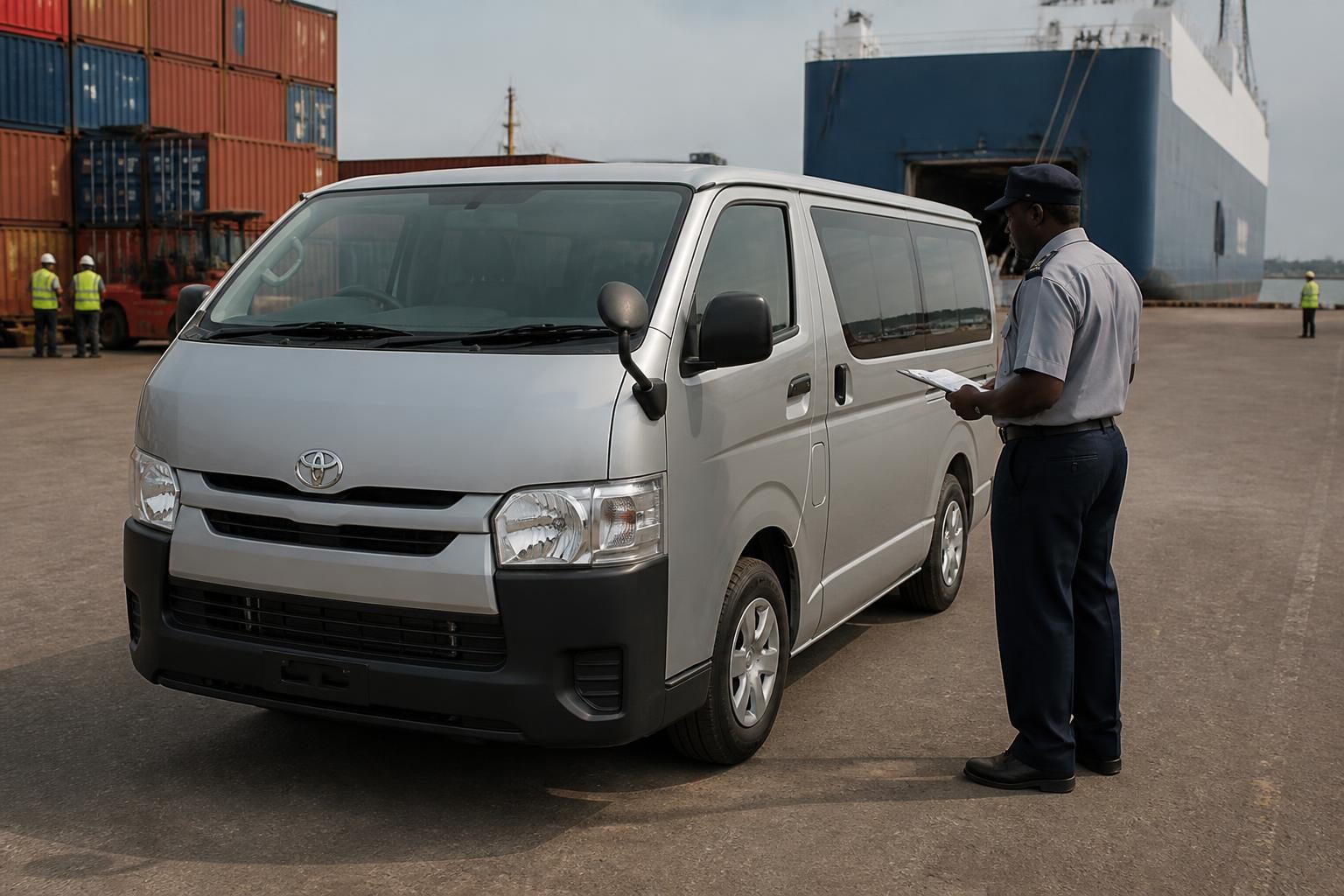
A customs officer inspects a silver van at a container terminal.
The practical effect is easy to misjudge. Compared with a sub-2,000cc import, you're adding an extra excise layer that then compounds through the rest of the calculation. Tanzanian customs duties are assessed on the Japanese Yellow Book value (the standard JDM price guide used by TRA to determine the dutiable amount) rather than what you paid, which is another reason a general rule of thumb won't get you close.
Never treat the listed USD price as the on-road total. An all-inclusive listing price covers the vehicle, sea freight and pre-shipment inspection. It excludes import duty, VAT and customs clearance, which you pay separately to the TRA. Every vehicle page carries an "Estimated landed cost in Tanzania" panel; that panel is where the real number lives, and the final figures arrive on your proforma invoice.
Then there's age. Vehicles older than 8 years attract an additional excise charge. Under the Finance Act 2026 (Tanzania Revenue Authority, effective July 2026), the rate for non-utility vehicles is 18% for those aged 8–10 years, 35% for those aged 10–20 years, and 40% for those over 20 years.
Whether a particular Hiace falls into the utility category depends on how it's registered on the Japanese export certificate. A passenger-bodied van registered as a passenger vehicle is typically treated as non-utility. A goods-body or cargo van registered as a freight vehicle may qualify for the lower utility rate. Check the registration category on the auction sheet and confirm the classification with TRA — the landed-cost estimate on the specific vehicle page is your starting point, and the utility-vehicle rate is covered on Carbarn's import rules page.
Which Model Years Should You Target, and Why Does Pre-2018 Need Care?
For a 2026 purchase, 2018 and newer is the clean answer, purely because of the 8-year age charge. Anything manufactured in 2017 or earlier crosses that line and picks up the extra excise, on top of the 10% engine-capacity excise the 2.8 diesel already carries.
Model year vs the 8-year charge (as at 2026)
Manufacture year
Age at import
8-year age excise
2024
2 years
Does not apply
2023
3 years
Does not apply
2021
5 years
Does not apply
2018
8 years
Watch the cut-off closely
2017
9 years
Applies
2016 or older
10+ years
Applies
The 2018 to 2021 window is the practical sweet spot. Those years carry the 1GD-FTV in H200 facelift specification, sit clear of the age charge, and generally land in the $10,000 to $15,000 band before duty. A 2023 or 2024 unit will be cleaner with lower mileage, but the landed cost climbs steeply because duty scales with value.
A 2017 isn't unbuyable — it's the same drivetrain and often better value on paper. Just run the landed-cost estimate before you decide, because the age charge can quietly erase the saving. At that end of the range, condition and odometer reading matter more than the year printed on the export certificate.
Buying a Hiace 4WD Through Carbarn
Every vehicle listed on Carbarn Tanzania is owned outright by Carbarn, so there's no broker in the middle and no third-party cancellation. Before you pay anything you see two inspection reports: the official Japanese auction sheet, which is the grading document produced at auction, and an in-house Carbarn inspector report. For a Hiace specifically, that auction sheet is how you confirm the drivetrain, which matters given how many JDM units are 2WD.
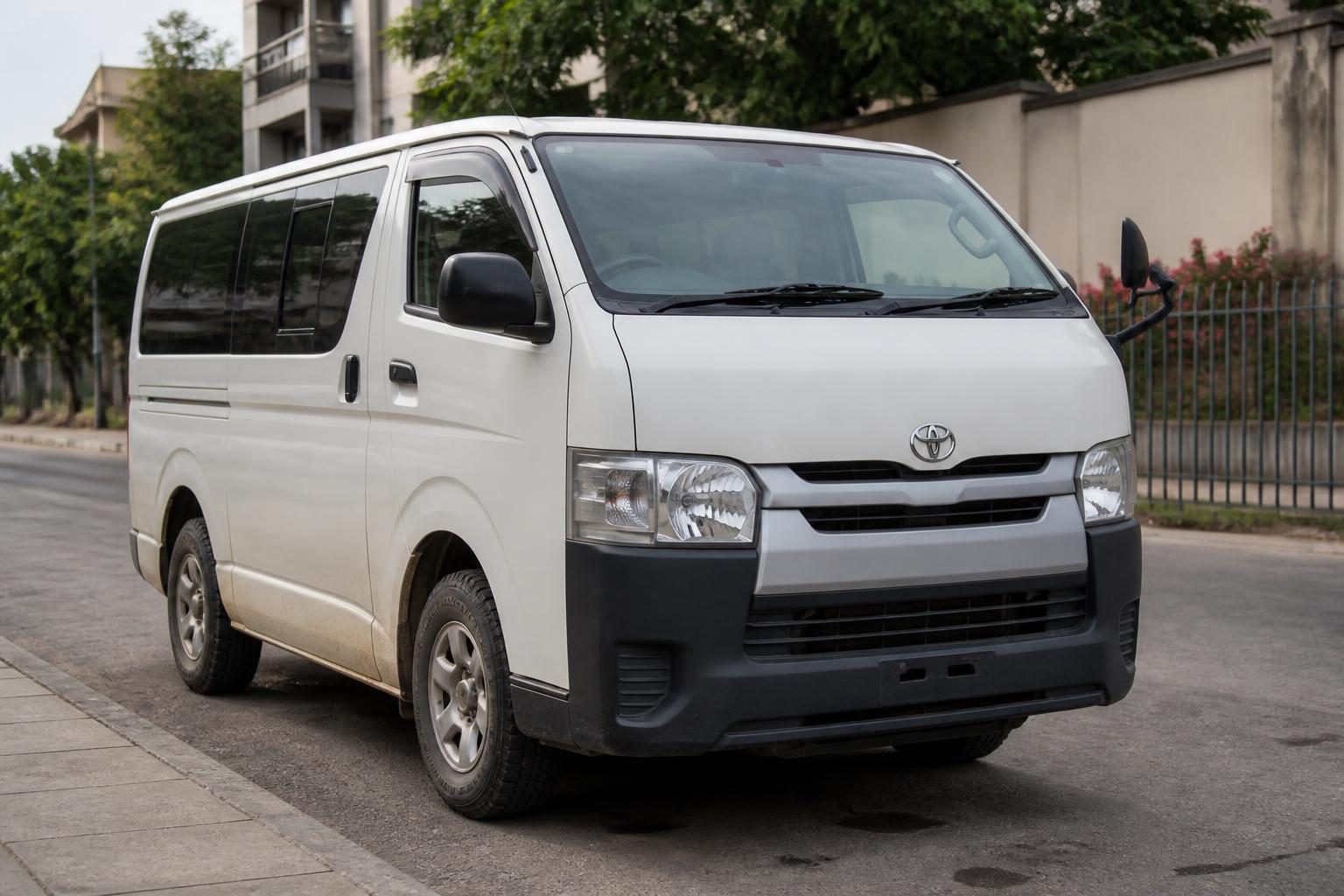
2021 Toyota Hiace 4WD
A confirmed 4WD example gives you a sense of the specification: a 2021 Toyota Hiace 4WD in the VAN LONG DX trim, 1GD-FTV 2.8 diesel, silver, 117,000 km on the odometer, auction grade 3.5, standing 1,980 mm tall. Grade 3.5 is a mid-range auction grade: honest working condition with cosmetic wear noted on the sheet, not a showroom car.
Vehicles ship by RoRo (Roll-on Roll-off vessel, the standard method for car exports from Japan) to Dar es Salaam, typically 25 to 35 days at sea. An EAA pre-shipment inspection (a roadworthiness check carried out in Japan before loading) is included, along with the mandatory inspection on arrival. Pricing is quoted in USD and covers vehicle, shipping and inspection; import duty, VAT and clearance are separate and appear in the per-vehicle landed cost estimate. Payment runs through Carbarn Japan by bank transfer or card, with details issued on the proforma invoice after your quote is confirmed. Invoices, inspection sheets, the bill of lading, certificates and live vessel tracking all sit in the self-service dashboard. Browse the full Toyota Hiace range, read the buying process, or check eligibility on the import rules page.



 A white minibus travels along a dusty rural dirt road.
 A customs officer inspects a silver van at a container terminal.
 2021 Toyota Hiace 4WD