You've found a used car in Japan, the photos look clean, and the price works. Then a friend mentions "TBS" and you start to wonder whether the car will be stopped at the port in Dar es Salaam. The short answer is yes, a used car from Japan does fall under TBS control, but the inspection happens in Japan before the car ships, not when it lands.
This guide explains what TBS actually requires, why Japan is handled differently from most other countries, what the penalty is if a car arrives without its certificate, and the questions to ask any seller before you pay.
Quick Answer
- Japan is a PVoC country, so TBS inspection of a used car happens in Japan before shipping.
- EAA Company Limited is the TBS-appointed used-vehicle inspection agent in Japan.
- A car arriving without a Certificate of Roadworthiness faces destination inspection plus a penalty of 15% of the total invoice value, assessed by TRA, according to the TBS penalty document for un-inspected used motor vehicles (read 16 November 2026).
- A car that fails inspection in Japan is repaired by the exporter and re-inspected before it ships.
- The simplest safeguard is to confirm the inspection in writing before you pay.
What does TBS require for a used car from Japan?
TBS requires every used car shipped from Japan to be inspected in Japan and to arrive with a Certificate of Roadworthiness. If the car lands in Dar es Salaam without that certificate, it goes through destination inspection and attracts a penalty. One inspection, done at the Japanese end, is the whole requirement for a compliant car.
A few terms are worth knowing before you order. TBS is the Tanzania Bureau of Standards, the agency that checks imported goods meet Tanzanian standards. PVoC stands for Pre-shipment Verification of Conformity, TBS's programme for inspecting goods in the exporting country before they ship. Destination inspection, or DI, is the opposite: the check happens after arrival in Tanzania.
The Certificate of Roadworthiness is the document the inspection agent issues when a used car passes its PVoC check. For a used car it plays the role a Certificate of Conformity plays for general goods. The TBS Destination Inspection page states that items regulated under PVoC and imported without a Certificate of Conformity "shall be subjected to penalties" (TBS, Destination Inspection page, read 16 November 2026).
The table below shows how the two routes compare for a buyer. The grouping follows TBS's 2026 destination inspection procedure, which lists Japan, the UAE and the UK as countries where cars are inspected before shipping.
|
Car from Japan, the UAE or the UK |
Car from a country where TBS has no inspection agent |
| Where inspected |
In the exporting country, before shipping |
In Tanzania, after arrival |
| Who inspects |
A TBS-appointed agent (EAA Company Limited in Japan) |
TBS, under the destination inspection procedure |
| Document issued |
Certificate of Roadworthiness before the car ships |
Clearance after inspection at destination |
| What it means for you |
Any defects are found before the car leaves Japan |
You learn about problems only once the car is in Dar es Salaam |
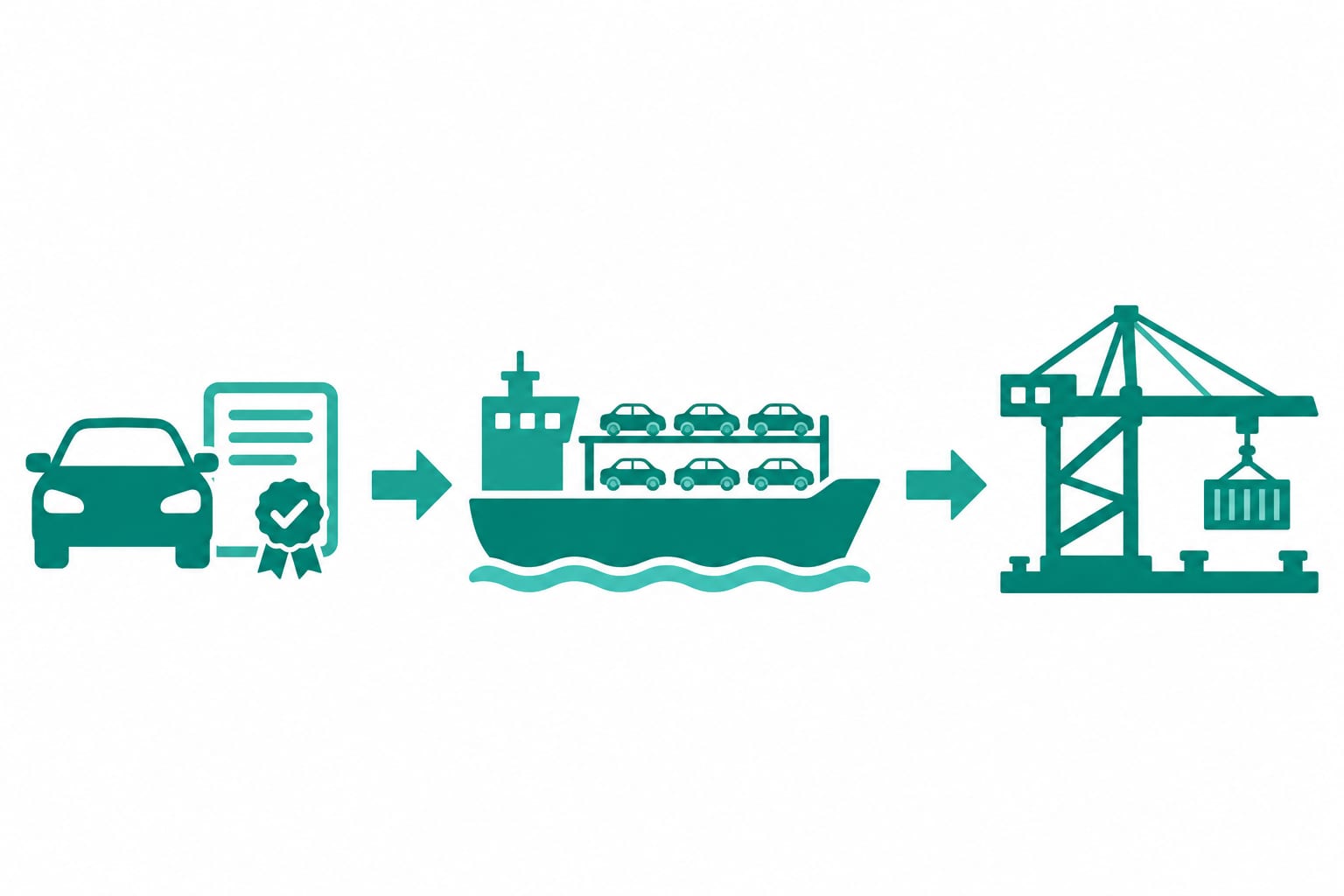 Illustration: The inspection happens in Japan before the car ships, not at the port in Dar es Salaam. Illustration.
Why is Japan treated differently from other countries?
Japan is treated differently because TBS has an appointed inspection agent there. Where TBS has an agent in the exporting country, it inspects before shipping. Where it has none, it inspects at destination. Japan has a TBS agent, so Japanese used cars sit in the pre-shipment group, not destination inspection.
For a used car bound for Tanzania, TBS names EAA Company Limited as its used-vehicle agent in Japan. If a seller offers you a certificate from a different company, ask how it meets the TBS requirement before you accept it.
The practical result is simple. One inspection, done early, at the exporter's end, and the car arrives with its paperwork already in order. Any roadworthiness problems surface in Japan, where the exporter can fix them, rather than at the port in Dar es Salaam.
Keep in mind that the TBS inspection is a roadworthiness check. It is separate from reading the car's auction sheet, which tells you about accident history and condition grading. Our guide to what an auction sheet can tell you before you buy covers that side.
What does the 15% penalty mean in practice?
The penalty is a percentage of the car's invoice value, charged on top of destination inspection when a used car from a PVoC country arrives without its Certificate of Roadworthiness. TRA, the Tanzania Revenue Authority, assesses it at clearance. It is a charge for arriving un-inspected, not a fine for a car that fails.
TBS's penalty document says a used car from a PVoC country without a Certificate of Roadworthiness goes through destination inspection with a penalty of 15% of the total invoice value, as assessed by TRA. The source is TBS's Penalty for Un-inspected Used Motor Vehicles Regulated under PVoC Programme, linked from the TBS Destination Inspection page and read on 16 November 2026.
"Total invoice value" means the figure on the commercial invoice for the car. It is the amount the seller billed you. The penalty is calculated on that amount as TRA assesses it.
Two points follow from this. First, the penalty is in addition to the destination inspection itself, and in addition to everything you would normally pay when the car is cleared with TRA. Second, it is avoidable. A car that leaves Japan with its Certificate of Roadworthiness never enters this process.
Check the current penalty document on the TBS Destination Inspection page before you rely on any figure, and treat the version linked there as the one that applies.
What happens if a car fails inspection?
A car that fails its inspection in Japan is repaired by the exporter and re-inspected before it ships. At destination, TBS's procedure makes any clearance permit conditional, and a car that can't be repaired is returned to its origin or destroyed at the importer's cost. A failure in Japan is a seller's problem to fix. A failure in Dar es Salaam is yours.
This is the real reason the pre-shipment step matters. When the inspection is done in Japan, any defect is found while the car is still with the exporter. The exporter arranges the repair, the car is re-inspected, and the Certificate of Roadworthiness is issued before the vessel leaves. You may never hear about it.
If a car arrives without a certificate and then fails destination inspection in Tanzania, the picture is different. You have already paid for the car and the shipping. You now face the penalty, a repair to arrange, storage at the port while that happens, and the possibility of the car being returned to its origin or destroyed at your cost if it can't be repaired.
Put plainly, a failed car at destination is one of the most expensive outcomes an importer can face. Nothing in the paperwork can make it cheap. The only reliable protection is confirming, before you pay, that the inspection in Japan is part of the deal.
What should you check before you order?
Before you pay for any used car from Japan, confirm in writing that the EAA pre-shipment inspection is included and that a Certificate of Roadworthiness will be issued. Then check that the paperwork describes the exact car you're buying. These questions work with any seller, and clear written answers are a good sign.
 Illustration: Vehicle inspection forms with car diagrams and a car key on a wooden desk.
Use this list as a script when you talk to a seller:
- Is the EAA inspection included, and will the car ship with a Certificate of Roadworthiness? A yes should come with an explanation of who books the inspection and when.
- Who pays the inspection fee, and is it in the quoted price? If the seller says it is extra, get the amount in writing before you commit.
- Do the model year, chassis number and engine details on the paperwork match the car? Compare the invoice, the auction sheet and the inspection booking. One mismatch can hold up clearance.
- Will you receive copies of every document? You want the invoice, the inspection report, the certificate and the bill of lading, ideally in one place you can access at any time.
- Is anything about the inspection status unclear? If a seller is vague about who inspects the car or when, treat that as your answer. Ask again, and don't pay until it's clear.
Once the car arrives, it is cleared with TRA using the documents from the seller.
How buying through Carbarn handles the inspection
If you'd rather not chase a seller for inspection confirmation, Carbarn builds it into the order. The buying guide on carbarn.tz states that the final price includes shipping and EAA inspection, and that step four of the process is completing the EAA pre-shipment certification before the car is booked on a vessel.
In practice that means the Certificate of Roadworthiness question is answered before you pay. The car is inspected in Japan, the inspection report is available in your dashboard alongside the invoice and bill of lading, and the car ships with its certificate. The listed price covers the car, shipping and inspection. It doesn't cover what you pay when the car is cleared with TRA.
The full five-step process, from choosing a car to tracking the vessel, is set out on the how to buy page. If you want to see what's on offer, you can start with the Toyota range.