If you live in Tanzania and you’re serious about one car that can do everything, the Toyota Noah keeps popping up for a reason. It carries a full family, handles school and church runs, works as an airport shuttle, and still feels easy enough to drive around Kariakoo traffic or squeeze into a tight slot at Mlimani City. It is not as thirsty as a big SUV or Hiace, but it gives you far more space and comfort than a normal saloon.
As of 2025, when people type “Toyota Noah for sale”, they’re really asking three questions:
How much should I pay for a good Noah in Tanzania right now?
Which one should I pick – classic old model, mid-range or the latest hybrid Toyota Noah new model?
Is it better to import or buy locally and let someone else handle the stress?
This guide is built to be the ultimate Toyota Noah blog for Tanzania, combining real-world price bands, clear explanations of Toyota Noah fuel consumption, engine capacity, old model vs new model insights, and practical buying advice. Throughout, we’ll also show how Carbarn Tanzania fits into your decision if you want a safer, more transparent way to buy.
Key Answers About the Toyota Noah 2025 in Tanzania
In simple language: the Toyota Noah is for families, school transport operators, churches, tour and shuttle services, and small businesses that need a comfortable 7–8 seater with better fuel economy than a big SUV or diesel bus.
In terms of price, older Noahs often sit roughly in the TSh 6.5–10 million range, mid-level imports move into around TSh 15–25 million, and newer shape or hybrid Noah units typically land somewhere between TSh 25–40+ million, depending on condition, mileage, trim and taxes.
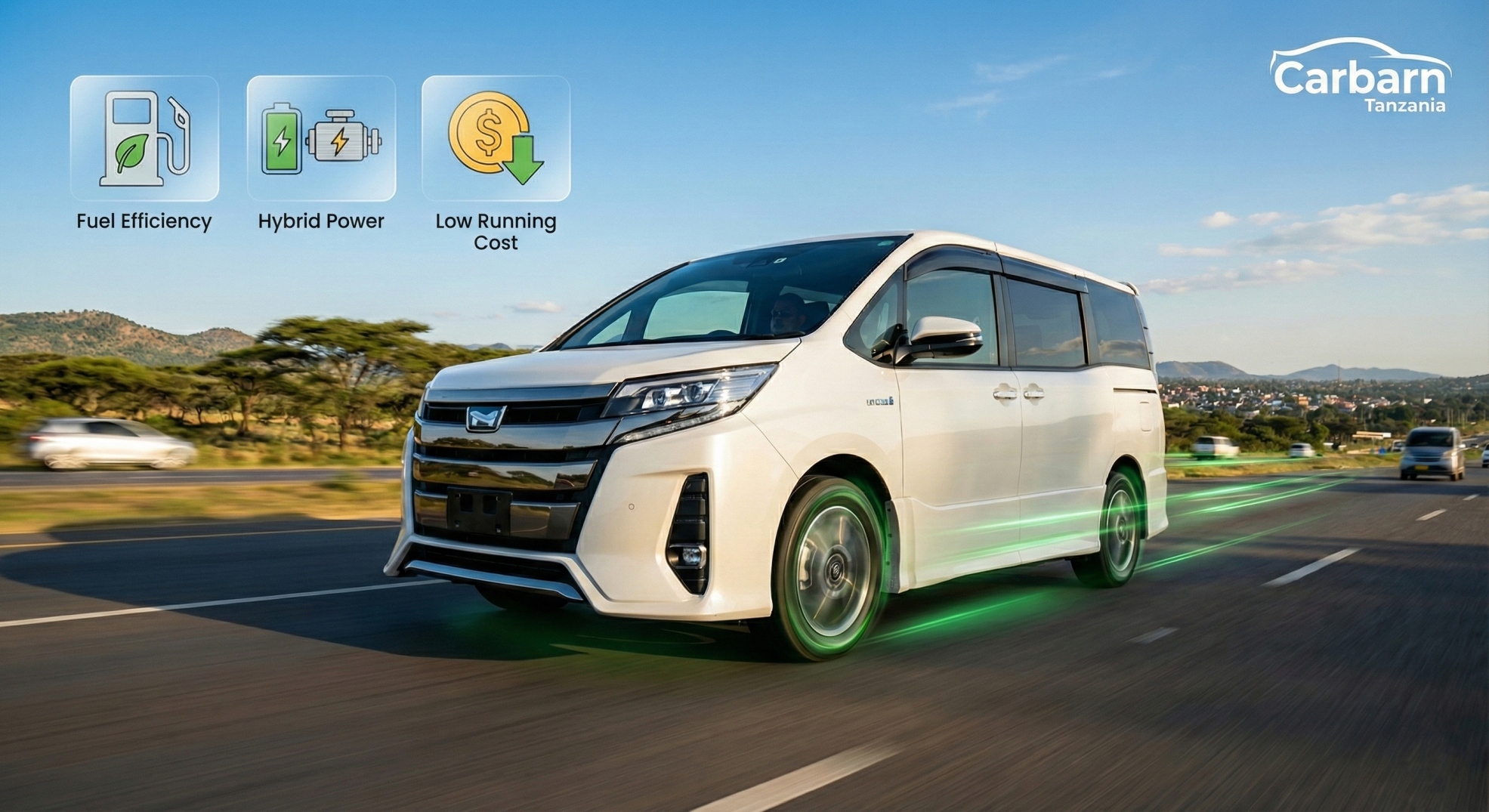
The Toyota Noah hybrid that came with the latest generation pairs a 1.8L engine with an electric motor and can achieve around 23–24 km/L in test cycles. In everyday Tanzanian traffic that still translates into a very visible saving at the pump compared to a pure petrol MPV.
For Tanzanian roads, the Noah has enough ground clearance for city and most up-country tarmac and graded roads. For serious mud or bush tracks, you still want a proper 4×4, but for Dar es Salaam, Dodoma, Arusha, Mwanza and most intercity routes, the Noah is perfectly at home.
When it comes to import vs local, importing lets you access fresher stock and hybrids, but you must understand CIF, roughly 25% import duty, excise based on engine capacity, 18% VAT and any age-related costs. Local purchase is simpler because you see and drive the car in front of you, especially if a specialist like Carbarn Tanzania has already done the heavy checks.
Why the Toyota Noah Works So Well in Tanzania
Tanzania’s used car market is expanding as more people enter the middle class and as new car prices stay out of reach for most households. The focus is on practical, fuel-efficient Japanese models with easy access to spare parts. That is exactly the space where the Toyota Noah shines.
A saloon car might be fine for a couple, but once you have children, relatives visiting from up-country, or you start running a school route or church transport, the limitations appear very quickly. The Noah solves this by offering three rows of seats, a tall roof, a flat floor and dual sliding doors that make life easier in crowded streets and tight compounds.
For many families, the Noah is the vehicle that takes kids to school during the week, carries the extended family to church on Sunday and then drives everyone to the village when holidays arrive. For business owners, it doubles as a staff shuttle, hotel transfer van or tour feeder vehicle. That flexibility is why searching for “Toyota Noah used in Tanzania” is becoming so common.
What Exactly Is the Toyota Noah?
The Toyota Noah is a compact MPV/minivan that sits below the luxury Alphard/Vellfire twins and above smaller wagons. It started life sharing a lot with the Toyota Noah TownAce, Field Tourer and Road Tourer vans many Tanzanians know. Classic versions like the Toyota Noah SR40 still roam our roads in both passenger and mixed-use setups.
Under the bonnet, most Noahs heading to Tanzania come with around 2.0L engine capacity. You’ll often see figures close to 1998cc, powered by well-known Toyota petrol engines. These are simple enough for local mechanics to understand, yet powerful enough to move seven or eight people without struggling up the hills, leaving Morogoro or climbing into the Southern Highlands.
The newer Toyota Noah new model adds a 1.8L hybrid option, pairing a petrol engine with an electric motor and battery pack. This is where fuel savings really become noticeable, especially if the car lives in Dar es Salaam traffic.
Step inside and the Noah makes its mission clear: people first. A tall roof and flat floor mean grown adults can move between rows without twisting like a pretzel. Seats slide, fold and sometimes flip up completely, letting you choose between eight people plus small bags, or fewer people and more luggage. Storage pockets, cupholders and under-floor compartments make it easy to keep the cabin tidy on long trips.
The driving position is high, so you see over most cars, and the big glass area helps with visibility in crowded streets. Recent models add big touchscreens, reverse cameras and more advanced safety systems, but even older Toyota Noah used examples usually have solid A/C and comfortable seats, which are the real day-to-day essentials.
Toyota Noah Price in Tanzania (2025): What You Should Expect to Pay
When you start looking for a Toyota Noah for sale, you’ll quickly see there is no single “correct” price. Instead, there are bands depending on age, condition and whether the car was imported recently or has been in Tanzania for many years.
At the entry level are the true old models – vehicles that share DNA with the TownAce and early SR40 generation. These are the vans people are thinking of when they search “Toyota Noah old model price” or even “Toyota Noah old model price in Tanzania”. If they are still structurally sound and running reasonably well, they can often be bought for a figure at the lower end of the market, roughly starting from around TSh 6.5 million upwards depending on how much life is left in them. A specific case is the Toyota Noah 2000 price, which tends to sit in this more affordable zone if the vehicle has been used locally for some time.
Step up into more modern shapes and the price climbs, but so does comfort, safety and general refinement. Clean mid-range Noahs that many buyers feel comfortable using as family cars or customer shuttles tend to sit in that TSh 15–25 million window. In this zone, you’ll often see mentions of popular years like a Toyota Noah 2012 or a Toyota Noah 2013, but the exact year becomes less important than condition, mileage and how carefully it has been maintained.
At the top of the ladder, you find the latest shapes and hybrid variants, including recent Toyota Noah 2014-era examples and the current hybrid generation. These can easily land in the TSh 25–40+ million zone, especially when they have lower mileage and strong options.
So, what is a realistic shopping budget? For most Tanzanian families or small businesses wanting a respectable, comfortable Noah that won’t embarrass them at weddings or client pick-ups, a sweet spot is somewhere in that TSh 18–30 million range. With patience and a good dealer, you can usually find a car in this bracket that balances age, condition and features nicely.
Toyota Noah Fuel Consumption: How Thirsty Is It Really?
Fuel is a major expense in Tanzania, so Toyota Noah fuel consumption is a critical question. The honest answer is that it depends heavily on which Noah you choose and how you drive it.
Older models like the Toyota Noah SR40 or the early Toyota Noah TownAce-based designs, especially if heavily loaded and driven aggressively, will naturally use more fuel. Owners who never service them on time or drive them only on short city trips often see disappointing numbers. That is why you’ll sometimes hear complaints about Toyota Noah SR40 fuel consumption – in many cases it’s more about the specific car’s condition than the basic design.
Move into fresher generations with improved engines and transmissions and things improve. In mixed Tanzanian driving, a healthy 2.0L petrol Noah can realistically sit around the 10–12 km per litre mark if it’s driven sensibly, tyres are correctly inflated and services are done on schedule. For a 7–8 seater vehicle with a tall body, that’s not bad at all.
The real game-changer is the hybrid Toyota Noah new model. Here, the petrol engine is assisted by an electric motor, and at low speeds the car can often move mostly on electric power. In heavy Dar es Salaam traffic or stop–go situations in Arusha, this makes a big difference. In real-world use, it’s quite possible to cut fuel usage by roughly a third compared to a similar purely petrol Noah. Over a year of school runs, hotel shuttles and church trips, that translates into a significant saving – not just on paper but in your daily budget.
Is the Toyota Noah a Good Fit for Tanzanian Roads and Lifestyles?
Short answer: yes. The Noah’s dimensions, ground clearance and driving style match Tanzania surprisingly well.
In the city, the higher driving position lets you see over saloons and smaller hatchbacks, which is calming in messy traffic. The body is still compact enough to manoeuvre through downtown Dar, Kigoma streets or busy markets when you need to, especially thanks to the short bonnet and good steering angle. Sliding doors are a blessing in tight parking, letting children and older passengers get in and out without banging other cars.
On the highway, the Noah settles into a comfortable cruise. The 2.0L engine has enough power for overtaking when driven with respect, and the cabin is stable and refined enough for long journeys. You’ll feel crosswinds a bit more than in a low sedan, but in exchange you get space and comfort that a tiny hatch cannot match.
Up-country, the Noah handles most tarmac and graded roads without drama. It’s not a Land Cruiser, so you don’t want to treat it like one, but for most regional trips, especially those done on main roads, it does just fine. If your daily life involves mud tracks, deep ruts or loading building materials, then a 4×4 pickup or SUV makes more sense; but for typically mixed urban and highway usage, the Toyota Noah is one of the most versatile choices on the market.
Toyota Noah vs the Usual Alternatives (Voxy, Serena, Hiace, SUVs)
In Tanzania, Noah doesn’t exist in a vacuum. People cross-shop it with the Toyota Voxy, Nissan Serena, Toyota Hiace and a range of SUVs.
The Toyota Voxy is essentially Noah’s twin. Same basic platform, similar engines, almost identical running costs. The choice often comes down to which front design you prefer and which one you find in better condition within your budget.
The Nissan Serena is another strong MPV player, particularly in hybrid form. It can be very efficient and comfortable, but Toyota has the advantage in Tanzania when it comes to parts availability and mechanics familiar with the brand. Many buyers feel safer sticking with a Noah because nearly every town has someone who has worked on Toyotas their entire career.
The Hiace dominates the commercial and daladala space. It carries more people and cargo, and it takes abuse well, but the cabin feels more “work van” than “family car”. If your main goal is transporting paying passengers in basic conditions, a Hiace is fine. If you want your family or hotel guests to be genuinely comfortable, the Noah is much nicer to live with.
Then there are the SUVs. A RAV4, Harrier or similar will give you higher ground clearance and a tougher look, but they simply do not match a Noah’s ability to carry seven or eight people with luggage. Their fuel consumption can also be similar or worse than a Noah, especially older petrol SUVs. For people whose main job is carrying people, not going deep off-road, the Noah is often the smarter long-term choice.
Importing a Toyota Noah vs Buying Locally in Tanzania
Many Tanzanian buyers face the “import vs local” decision when hunting for a Toyota Noah for sale.
Importing directly lets you choose from a massive pool of cars, including fresh hybrids and current Toyota Noah new model options. You can target specific trims, colours and option packages. However, you must really understand how CIF works, estimate roughly 25% import duty, calculate excise based on engine capacity and age, add 18% VAT and include port, clearing and registration costs. A car that looks cheap in dollars can quickly become expensive in shillings if you miscalculate.
Buying locally means you see the actual vehicle, touch it, drive it, hear the engine and spot any rust or poor repairs before you pay. Someone else has already navigated shipping, TRA processes and port fees. The flip side is that you may pay a bit more than the raw CIF number because the importer or dealer has to cover risk and overheads.
This is where a specialist like Carbarn Tanzania becomes powerful. Instead of leaving you alone to decode auction grade sheets and tax tables, Carbarn can shortlist good-quality Toyota Noah units, explain the full landed cost clearly and back the car with local support. You get many of the benefits of importing, without the same level of risk and confusion.
Real-World Running Costs: Fuel, Maintenance and Resale
To understand whether a Noah really makes sense, look beyond the sticker price.
Fuel we’ve already covered: a well-maintained petrol Noah can give you about 10–12 km/L in typical Tanzanian use if driven sensibly, while the hybrid version can push significantly higher. Over a year of heavy usage, the difference between a petrol and a hybrid Noah can easily reach TSh 2–2.5 million in fuel savings.
Maintenance is straightforward if you respect the car. Regular oil and filter changes, checking plugs and cooling systems, and looking after suspension components that handle Tanzania’s speed bumps and rough patches go a long way. Sliding doors and seat rails need occasional cleaning and lubrication to keep them moving smoothly. For hybrids, the battery pack is designed to last many years; still, it is wise to set aside a long-term contingency fund in case you own the car deep into its life.
On resale, the Toyota Noah used market is very active. If you care for your car, fix issues properly and keep service records, selling later is usually not a problem. Toyota MPVs have a reputation for durability, and buyers know that. A clean Noah, especially a hybrid or well-specced petrol version, often sells faster and at a stronger price than many less-known models.
Who Is the Toyota Noah Really For in Tanzania?
The Noah is perfect if you often carry five to eight people and you want everyone to arrive relaxed rather than squashed. It’s ideal for parents who juggle school runs with weekend family road trips, for churches that need to move choirs or elders, for hotels that want comfortable airport transfers, and for tour operators who need a feeder vehicle to and from airports or bus terminals.
If you feel you are constantly borrowing or hiring a van whenever relatives visit, or if you’re running two small cars just to move the family, a Toyota Noah can simplify your life. It lets you join family, work and social duties into one flexible vehicle that makes more sense for Tanzania’s growing, busy lifestyle.
If you live in very remote villages with poor access roads, a genuine 4×4 might still be the wiser pick. But for the vast majority of urban and peri-urban Tanzanians, the Noah checks almost every box: space, comfort, reliability, respectable fuel economy and strong resale value.
Why Buy Your Toyota Noah Through Carbarn Tanzania
Scrolling random classified sites for “Toyota Noah for sale” gives you photos and prices, but not much peace of mind. You still wonder: is this mileage real? Has this car been in a big accident? Is the chassis straight? Are duties fully paid?
Carbarn Tanzania is built to remove those question marks. Instead of showing everything, Carbarn filters heavily, focusing on Toyota Noah units with clean histories, genuine odometer readings and strong mechanical condition. Vehicles are inspected with the Tanzanian buyer in mind, not just as anonymous export stock.
Pricing is laid out clearly – from vehicle cost to duty, port charges and registration. That means you see the true Toyota Noah price in Tanzania, not just a low headline figure with hidden extras later. On selected cars, Carbarn can also provide local warranty coverage on major components, plus help with nationwide delivery if you live outside Dar es Salaam.
In short, Carbarn Tanzania lets you enjoy the benefits of Japanese imports and hybrid technology, while leaning on a local partner that understands the roads, the regulations and what Tanzanian families and businesses actually need from a Toyota Noah.