The Dar es Salaam petrol cap for November 2026 is TZS 4,083 a litre, effective 4 November. That figure comes from the Energy and Water Utilities Regulatory Authority (EWURA) cap price notice for November 2026, and October's cap was TZS 4,057, so the rise is TZS 26, or about 0.6%.
The cap is the maximum retail price a station may charge at the pump. It makes the headlines, but it isn't what sets your fuel bill. The number of litres your car burns does that. A cap that moves by a few shillings changes little. A car that drinks twice as much as another changes everything.
This guide turns that cap into a cost per 100 km, shows why inland towns pay more, and ends with the kinds of car that make sense at these prices.
Quick Answer
- The Dar es Salaam petrol cap is TZS 4,083 a litre from 4 November 2026, up TZS 26 on October, per the EWURA cap price notice.
- Mwanza's cap is TZS 4,298 a litre in the same notice, so inland buyers feel every extra litre harder.
- Litres per 100 km move your monthly bill far more than the month-on-month cap change does.
- A smaller engine usually burns fewer litres per 100 km, so it costs less at the pump every week.
- Import duty, VAT and clearance are paid to TRA on top of a car's listed price.
What does EWURA's November 2026 petrol cap say?
EWURA's November 2026 notice puts the Dar es Salaam petrol cap at TZS 4,083 a litre from 4 November, up TZS 26 on October's TZS 4,057. Mwanza is listed at TZS 4,298. A cap is a maximum, so a station may sell below it but not above it. EWURA resets the cap every month, and December's figure may differ.
| Location and month |
Petrol cap (TZS per litre) |
| Dar es Salaam, November 2026 |
4,083 |
| Dar es Salaam, October 2026 |
4,057 |
| Change, October to November |
+26 (about 0.6%) |
| Mwanza, November 2026 |
4,298 |
The October figure comes from EWURA's cap price notice effective 7 October 2026, which set Dar es Salaam petrol at TZS 4,057 a litre.
EWURA's November notice ties the rise to higher freight and insurance costs on imported fuel, which it links to tensions in the Middle East, where Tanzania sources most of its petroleum products. The reason matters less than the pattern. The cap has sat above TZS 4,000 for two months in a row, and nobody buying a car today should plan around it falling back.
This guide sticks to petrol. The notice also sets diesel and kerosene caps, but a petrol buyer's decision rests on the petrol figure, so that is the one worked through below.
What does TZS 4,083 a litre mean per 100 km?
Your cost per 100 km is simply litres used per 100 km multiplied by TZS 4,083. A car using 5 litres per 100 km costs TZS 20,415 for that distance. A car using 12 litres costs TZS 48,996. The cap is the same for both drivers. The consumption figure is the whole difference.
| Illustrative consumption (not a specific car) |
Cost per 100 km at TZS 4,083 |
Cost per 1,000 km |
| 5 L/100 km |
TZS 20,415 |
TZS 204,150 |
| 8 L/100 km |
TZS 32,664 |
TZS 326,640 |
| 12 L/100 km |
TZS 48,996 |
TZS 489,960 |
Between the thriftiest and thirstiest rows, the gap is TZS 28,581 per 100 km. Over 1,000 km, which we assume here as a month of Dar es Salaam commuting and school runs, that gap grows to TZS 285,810. Over a year it runs into the millions of shillings, all from the same pump at the same cap.
Compare that with the cap change itself. November's TZS 26 rise adds TZS 2,600 a month to a driver covering 1,000 km at 10 L/100 km. That is real money, but it is small next to the consumption gap above. Choosing the car is the decision that moves the bill.
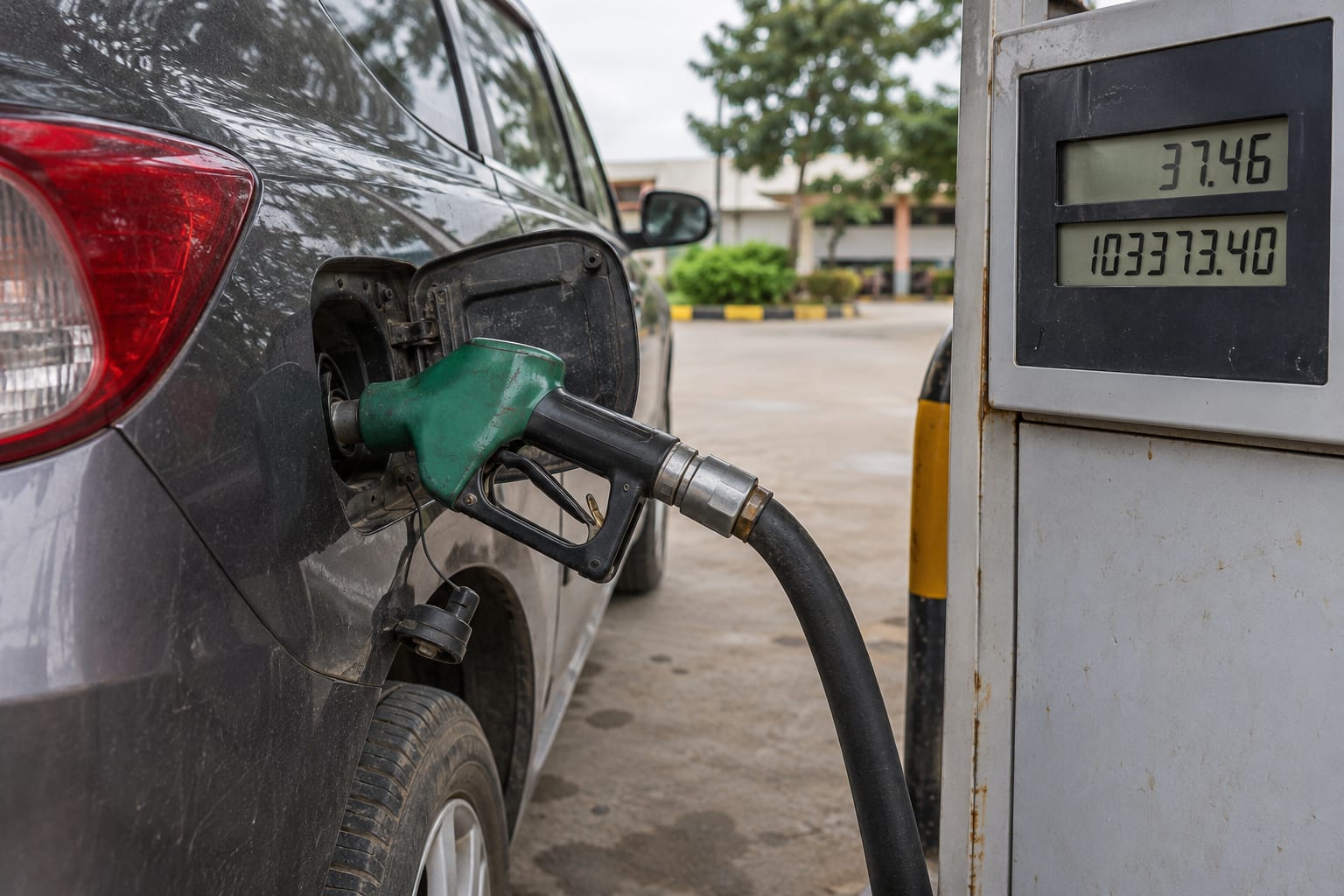 Illustration: Fuel nozzle inserted into a car beside a pump displaying 37.46 and 103373.40.
These three consumption levels are illustrations, not the figures of any named model. Real-world consumption in Dar es Salaam traffic also runs above the official catalogue figure for almost every car, because idling and stop-start driving burn fuel without covering distance. Use the formula with a realistic figure for the car you are weighing, not the brochure number.
Why do inland buyers pay more for petrol?
Inland towns pay more because EWURA's cap includes the cost of moving fuel from the coast. In the November 2026 notice, Mwanza's petrol cap is TZS 4,298 a litre, which is TZS 215 above Dar es Salaam, or about 5%. Fuel lands at Dar es Salaam port, and the distance to Lake Victoria is reflected in the cap.
The percentage sounds modest, but inland driving adds a second cost. Trips between towns are long, and long trips burn litres. At 8 L/100 km, every 100 km costs TZS 34,384 in Mwanza against TZS 32,664 in Dar es Salaam. Over a 400 km run, that is nearly TZS 7,000 extra for the same journey.
So fuel economy matters more upcountry, not less. A buyer in Mwanza, Arusha or Mbeya who covers long distances gains more from a frugal car than a Dar commuter does. Ground clearance and durability still count on rougher roads, which is why many inland buyers end up weighing a wagon against an SUV.
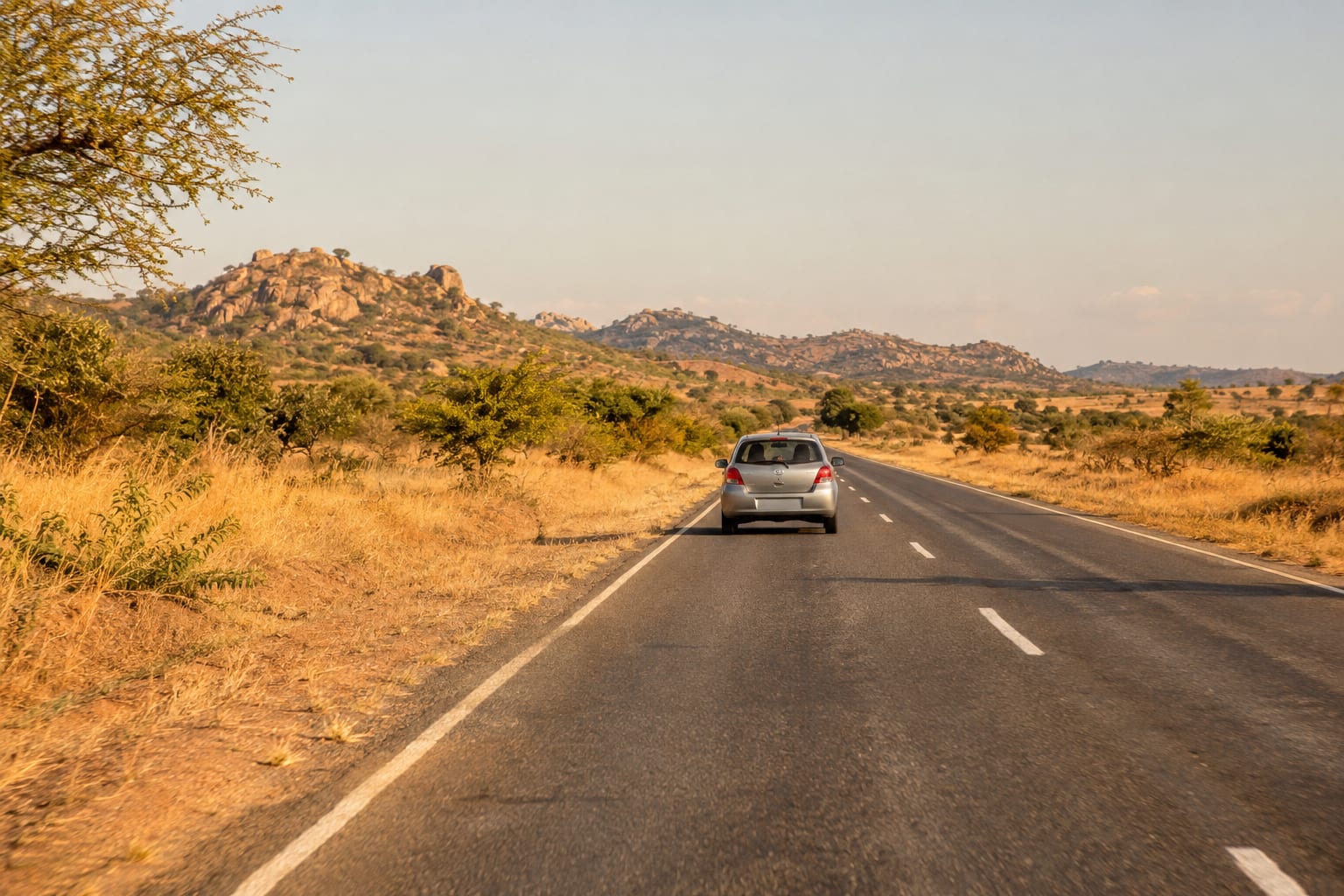 Illustration: A silver Toyota Yaris travels along a rural road amid dry grassland and rocky hills.
Which kinds of car suit a TZS 4,083 cap?
At TZS 4,083 a litre, the cars that make sense share two traits: low litres per 100 km and an engine of 2000cc or under. That points to hybrid hatchbacks and small petrol hatchbacks for most buyers, with larger SUVs reserved for people who truly need the space or capability. Here is how the main groups compare.
Hybrid hatchbacks
A hybrid hatchback such as the Toyota Aqua is probably the strongest fit for Dar es Salaam traffic. Hybrids recover energy in stop-start driving, which is exactly where ordinary petrol cars waste the most.
The trade-off is purchase price. Hybrids tend to cost more than a plain petrol hatchback of the same age, so the fuel saving has to be earned back over the kilometres you drive. If you cover long distances each month in city traffic, the fuel saving is more likely to pay back the extra cost, so compare the price gap on the Toyota model pages against the distance you actually drive. If you drive rarely, a cheaper small petrol car may suit you better.
Small-engine petrol hatchbacks
Small petrol hatchbacks in the Yaris and Swift class are the sensible budget choice. They use little fuel, cost less to buy than a hybrid. Browsing the full range of Japanese used cars for Tanzania by fuel type and year is a quick way to see what is in this class.
They suit first-car buyers, couples and anyone whose driving is mostly within the city. They are less at home on long upcountry runs with a full load, where a small engine works hard and consumption climbs.
Large petrol SUVs above 2000cc
Large petrol SUVs are the right choice for a buyer who genuinely needs seven seats, towing, or ground clearance for rough roads. For pure commuting in Dar es Salaam, they are poor value, because you pay for capability you rarely use, every week at the pump.
Diesel
Diesel is a separate question. The diesel cap moves on its own each month, and diesel cars carry different purchase prices and servicing patterns, so this guide does not compare them.
Which car makes sense for you?
The right car at a TZS 4,083 cap depends on where and how far you drive. Most Dar es Salaam commuters should lean towards a hybrid or small petrol hatchback. Families and upcountry drivers have more to weigh. Match your situation to the lines below.
- If you commute in Dar es Salaam traffic every day, a hybrid hatchback makes a lot of sense.
- If you drive long distances upcountry, fuel economy matters even more, because the cap is higher and the kilometres are longer. A frugal wagon or compact SUV with an engine under 2000cc is worth a look.
- If you need space for a growing family, compare a hybrid wagon or compact SUV before a large petrol SUV.
How does buying from Japan with Carbarn work?
Carbarn sells Japanese used cars direct to Tanzanian buyers. Before you pay, you see two inspection reports: the official Japanese auction sheet and Carbarn's own in-house inspector report.
The listed price covers the vehicle, shipping and inspection. It does not include import duty, VAT or clearance, which you pay to TRA.
Payment is by bank transfer to Carbarn Japan, with account details provided only on the proforma invoice, or by credit or debit card online. You can filter the full inventory for Tanzania by fuel type and year, then follow the step-by-step guide to how buying works when you are ready.
What this does not show
This post works from one month's petrol cap, so it does not show where the cap will sit in December or beyond. It does not cover the diesel or kerosene caps, which EWURA sets in the same notice but which move on their own. The cost-per-100 km rows are illustrations, not the measured consumption of any named model, and real Dar es Salaam traffic usually pushes consumption above the catalogue figure.
It also does not cover import duty, VAT or the landed cost of any car. TRA sets those for each car.
Method and sources
- EWURA cap price notice for November 2026, effective 4 November 2026, for the Dar es Salaam and Mwanza petrol caps and the reasons EWURA gives for the rise. Checked 21 November 2026.
- EWURA cap price notice for October 2026, effective 7 October 2026, for the October Dar es Salaam petrol cap of TZS 4,057. Checked 21 November 2026.
- Cost-per-100 km figures are arithmetic: litres per 100 km multiplied by TZS 4,083, using illustrative consumption levels rather than any named model.