In 2025, 5,782.48 km of the 34,673.5 km of trunk and regional roads assessed in Tanzania were in poor condition. That figure comes from Table 11.1 of the Ministry of Finance's Economic Survey 2025, checked on 23 November 2026. It works out to roughly one assessed kilometre in six.
A national figure is a useful starting point, but your daily route is what wears your car. The road from your house to the main highway may be far better, or far worse, than the average. This guide explains what the number covers, what it leaves out, and what to read on a car's inspection reports before you pay for an import.
Quick Answer
- 5,782.48 km of assessed trunk and regional roads were poor in 2025, per the Economic Survey 2025, Table 11.1.
- Most assessed roads were fair (18,456.24 km). Only 16.7% were poor.
- District roads sit outside the figure, so rural and feeder routes may differ.
- Ride height, tyre size and a clean underbody matter more than the badge.
- Read the underbody and suspension notes on both inspection reports before paying.
What did the survey measure on Tanzania's road condition?
The Economic Survey 2025 reports the condition of trunk and regional roads that were assessed during the year. Each assessed kilometre is graded good, fair or poor. The figures cover only the roads under TANROADS, the Tanzania National Roads Agency, so they describe the main network rather than every road in the country.
Trunk roads are the long-distance routes. They link regions to each other, to the ports and to the land borders. Regional roads connect district towns to that trunk network. Together they carry most of the country's long-haul traffic, which is why their condition is worth watching.
District, feeder and urban roads are not in these numbers. Those fall under TARURA, the Tanzania Rural and Urban Roads Agency, and are not part of this figure. If you live off a main road, the last few kilometres of your trip are probably outside this dataset.
"Assessed" is the key word. The 34,673.5 km total is the length that was inspected and graded in 2025, not necessarily every kilometre TANROADS manages.
What do the 2025 numbers show?
Most assessed main roads were fair, not poor. Good and fair roads together make up the large majority of the assessed length. Poor roads are a real minority at 16.7%, but still a long enough stretch to matter if one of those sections sits on your regular route.
| Condition |
Length (km) |
Share of assessed |
| Good |
10,434.78 |
about 30% |
| Fair |
18,456.24 |
about 53% |
| Poor |
5,782.48 |
16.7% |
| Assessed total |
34,673.50 |
100% |
The kilometre figures are taken from Table 11.1 of the Economic Survey 2025. The percentage shares are our own arithmetic from those figures, rounded, and should be read as approximate.
A fair road is not a bad road. It usually means a surface that is driveable at normal speed but carries patched sections, worn edges or occasional rough spots. A poor road is where potholes, broken shoulders and loose surface become the normal condition rather than the exception.
What do rough road surfaces do to a car?
Rough roads load the parts of a car that normally wear slowly. Potholes, broken edges and corrugated gravel send sharp, repeated shocks through the tyres, wheels, shock absorbers and suspension bushes. Over months, that speeds up wear that would otherwise take years. The points below are general mechanics, not survey data.
Tyres take the first hit. A pothole edge can cut a sidewall or bend a wheel rim, and low-profile tyres have less rubber to absorb the blow. Shock absorbers work harder on corrugations, and worn rubber bushes start to knock and loosen steering feel. The underbody, exhaust and plastic shields are next in line on roads with deep ruts or exposed rock.
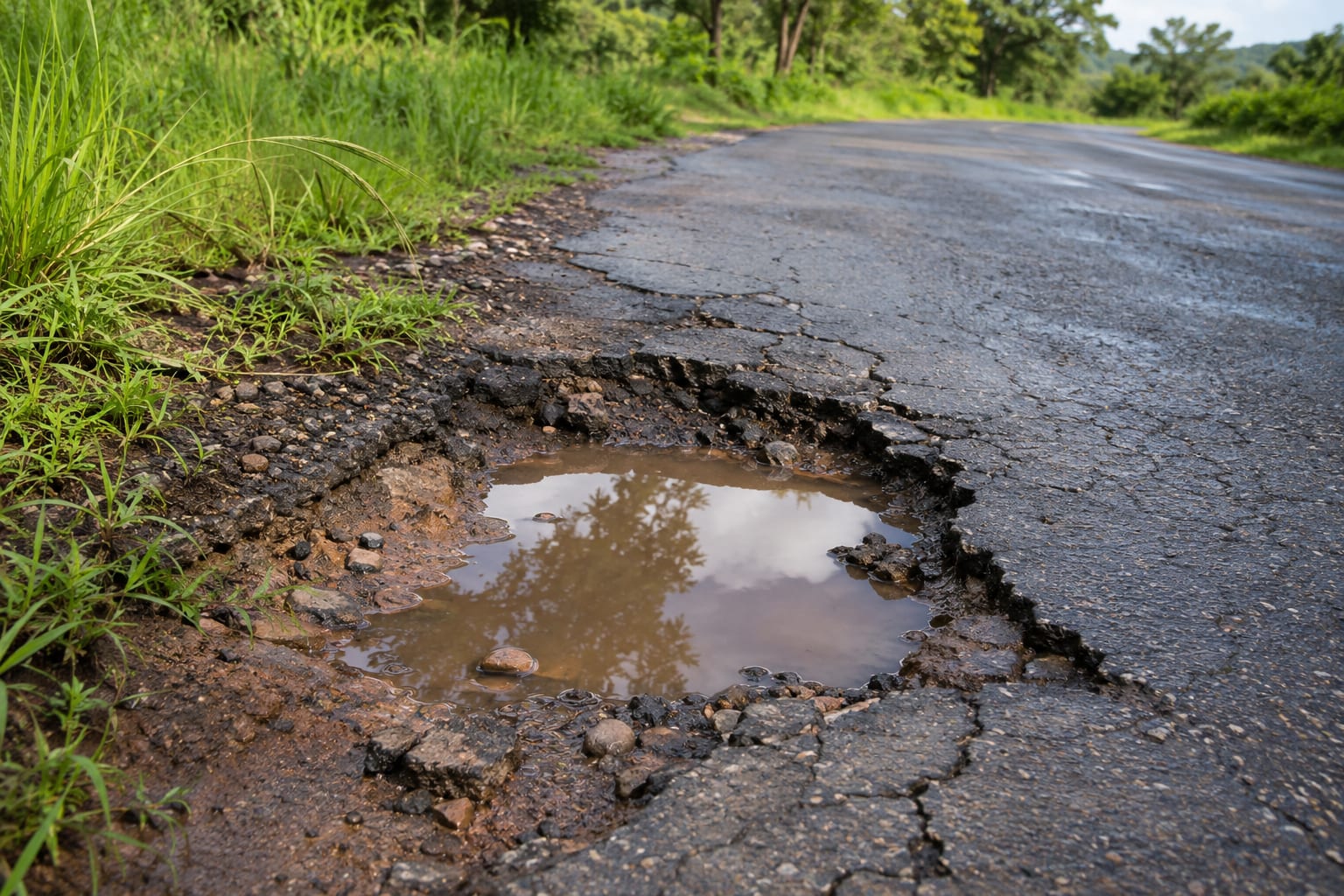 Illustration: A water-filled pothole and broken asphalt along a grassy rural roadside.
Poor roads are a minority of the assessed network, and your own route may never touch one. But averages hide local reality. A daily commute that crosses a single broken stretch twice a day puts more stress on a car than a long weekend trip on smooth tarmac. The wet season also changes conditions quickly, as water undermines edges and turns fair sections into poor ones until repairs catch up.
What should you check on the auction sheet and inspection report?
Read both reports with the underbody in mind, not just the paintwork. An auction sheet is the condition report written by the Japanese auction house before a car is sold. It carries an auction grade, a diagram marking dents and scratches, and short notes about the interior, the exterior and any repairs. An independent inspection report, written by someone who has physically checked the car, is the second document worth reading closely.
On the auction sheet, look beyond the grade. The grade summarises overall condition at a glance, and it does not predict how a car will age on a rough route. Notes about corrosion, rust on the underside, repaired panels or replaced parts tell you more about how a car has lived.
On the inspection report, go straight to the underbody and suspension sections. Useful details include the state of the shock absorbers, any leaks, cracked or perished bushes, uneven tyre wear and the depth of tread left. Uneven wear across a tyre can point to alignment or suspension problems rather than just old rubber.
If a report is vague on the underbody, ask before you pay. A short written answer about rust, suspension condition and tyre age costs nothing and settles the question. If you plan to drive regional routes, treat the underbody section as the most important part of either report.
Which car suits your route?
The right car depends on the roads you actually drive, not the national average. Use the survey as context, then be honest about your own route. The Tanzanian buyer who commutes within Dar es Salaam and the one who drives upcountry every month need different things.
If you mostly drive in Dar es Salaam on sealed surfaces, a lower, lighter car makes a lot of sense. A hatchback or sedan is easier to park, cheaper to run and simpler to maintain. Extra ground clearance would cost you fuel and tyre money for an advantage you rarely use.
If your route includes long regional runs or unsealed sections, shift the priorities. More ground clearance helps you clear broken edges and ruts without scraping the underbody. Taller tyre sidewalls absorb pothole impacts better than low-profile rubber and are easier to replace locally. Simple suspension, with fewer electronic or air components, is usually cheaper to repair when something does wear.
Vehicle type is a starting point, not a verdict. A wagon can be a sensible middle ground, offering space and often a touch more clearance than a sedan. An SUV suits mixed routes with regular rough stretches. A van suits business use where load and access matter more than ride comfort.
Higher cars are not free of trade-offs. They tend to use more fuel, their tyres cost more to replace and their taller stance changes how they handle at speed. If you are a city-only driver, you should probably skip the extra clearance. Match the car to your own roads, and let the survey remind you that those roads vary more than any headline figure suggests.
Carbarn: direct-from-Japan stock for Tanzanian roads
Carbarn sells used Japanese cars direct to Tanzanian buyers. Each listing shows the original Japan auction sheet alongside a Carbarn inspection report with photos, so you can read both before you pay. That is where the underbody and suspension checks described above come in.
Every car goes through an EAA pre-export inspection in Japan before shipping, and travels by RoRo vessel from Japan to Dar es Salaam. The listed price covers the vehicle, ocean shipping and the pre-shipment inspection. It does not include import duty or other Tanzanian import taxes, so check the estimated landed cost on each vehicle page. The reports and the photos on the vehicle page are how you assess a car. You can browse the inventory and filter by body type, year and auction grade to find cars that fit your route.