In February 2025, Toyota said Corolla Axio production would end at the close of October 2025, so every Tanzania buyer in 2026 is choosing from the used import pool, not a fresh pipeline (Toyota Motor Corporation production-end notice, 2025). That sounds simple until you realise the wrong year, drivetrain, or paperwork can wipe out the value that makes the Axio attractive in the first place. Is it still a smart buy? Yes, but only if you choose it like an importer, not just a Toyota loyalist.
Quick Answer
- Official Toyota WLTC figures put the Axio Hybrid EX at 27.8 km/L and the petrol CVT EX at 19.8 km/L (Toyota Japan Axio catalogue, 2025).
- As of 5 August 2026, Dar petrol was capped at TZS 3,898/L (EWURA August cap notice, 2026).
- Toyota lists a 461 L boot and 4.9 m turning radius, so the Axio stays practical in town (Toyota Japan brochure, 2025).
- The real decision is year, variant, inspection history, and landed-cost logic.
This is a buyer's checklist, not a generic review. We'll look at whether the Toyota Corolla Axio suits Tanzania, which version makes sense, what current fuel-price maths says, how age changes the value picture, and what paperwork you should see before money moves. If you want the rules page open while you read, keep the Tanzania import rules and regulations page nearby.
| Variant type |
Best for |
Watch-out |
| Axio Hybrid |
Dar commuters, fuel-focused buyers |
More system complexity than plain petrol |
| Petrol CVT |
Buyers who want a simple automatic sedan |
Weaker official economy than hybrid |
| Older petrol Axio |
Budget-first buyers |
Age and landed-cost logic matter more |
| 4WD Axio |
Niche traction need only |
Lowest official economy of the main set |
Variant guidance here combines Toyota's official Axio data with the live Corolla listing structure used for Tanzania buyers (Toyota Japan Axio catalogue, 2025; Toyota Corolla listings in Tanzania, 2026).
Is the Toyota Corolla Axio a good fit for Tanzania?
As of Toyota's August 2025 Corolla Axio brochure, the car is 4,400 mm long, 1,695 mm wide, carries a 461 L boot, and turns in 4.9 m (Toyota Japan brochure, 2025). That makes the Axio a genuinely good Tanzania fit if your priority is an easy city sedan, not extra ride height or rough-road clearance.
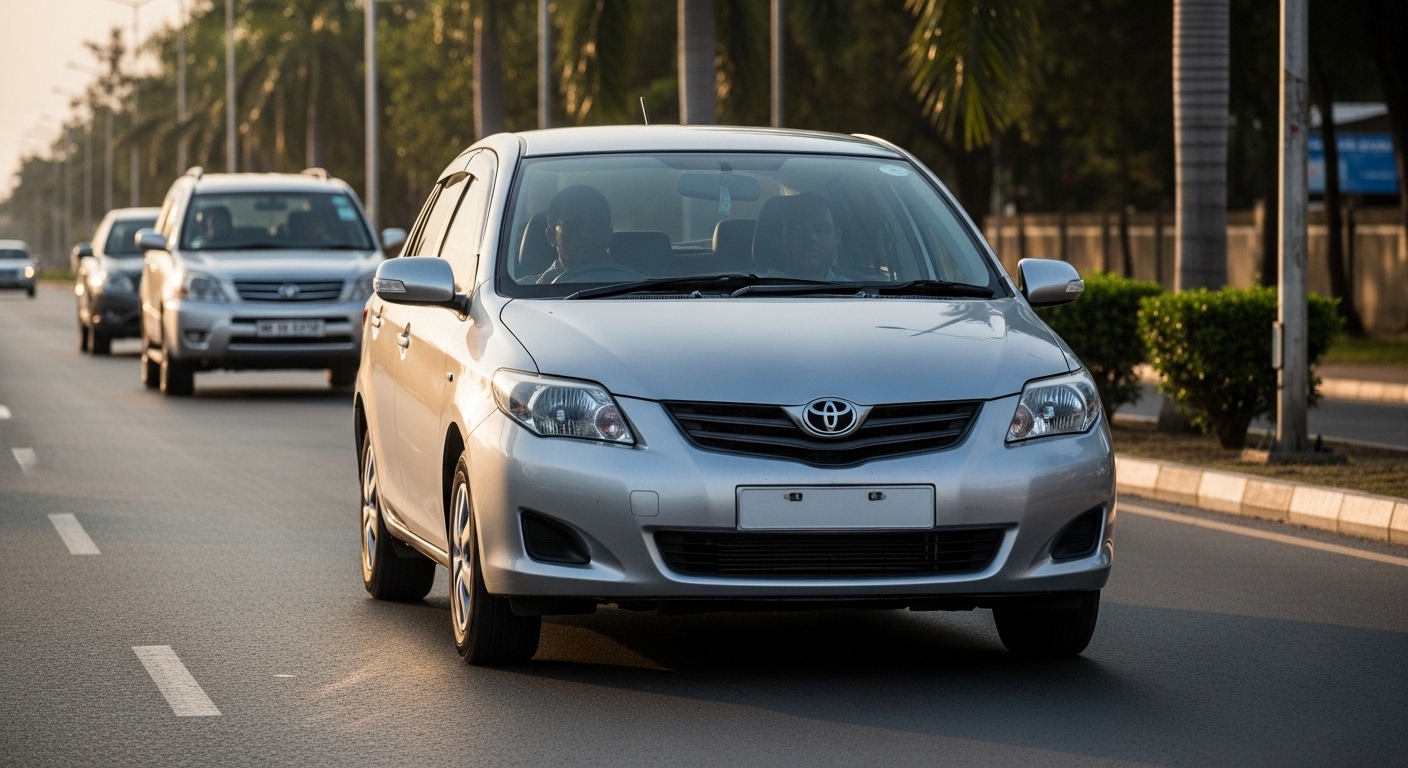 Silver Toyota sedan on a clean urban boulevard with palm trees in late afternoon light
The Axio works because it does the basics well. It isn't too long for tight parking, and it isn't so wide that busy city traffic feels stressful. That 4.9 m turning radius matters more than it sounds. In Dar es Salaam, where a quick U-turn or a neat parking move can save time, small differences add up fast.
The 461 L boot also gives the Axio more family usefulness than many hatchbacks. School bags, a weekly shop, and airport luggage fit more easily than you'd expect from a compact sedan. If you want a low-stress commuter that still handles family errands, it makes a lot of sense. If you need more cargo flexibility, though, the Toyota Corolla Fielder hybrid is worth a look.
Here's the trade-off. The Axio is not the right car for everyone. If you regularly drive on rough roads, want a higher seating position, or carry bulky loads, a taller crossover or a wagon may suit you better. That's the part many Axio guides skip, isn't it?
According to Toyota Motor Corporation's 2025 Corolla Axio brochure, the model's 4,400 mm length, 1,695 mm width, 461 L boot, and 4.9 m turning radius explain why it works so well as a practical city sedan in Tanzania (Toyota Japan brochure, 2025). Those numbers matter more than badge familiarity because they shape parking ease, family practicality, and day-to-day stress.
Axio versions to compare: hybrid, petrol CVT, manual, and 4WD
In Toyota Motor Corporation's current Axio catalogue, official WLTC fuel economy ranges from 27.8 km/L for the Hybrid EX to 19.8 km/L for the petrol CVT EX, 17.2 km/L for the petrol 5MT EX, and 15.6 km/L for the 4WD petrol CVT EX (Toyota Japan Axio catalogue, 2025). So the right Axio is really a usage decision, not a one-size-fits-all recommendation.
[CHART: Bar chart - Official Toyota Corolla Axio fuel economy by variant. Hybrid EX 27.8 km/L; Petrol CVT EX 19.8 km/L; Petrol 5MT EX 17.2 km/L; 4WD petrol CVT EX 15.6 km/L. Source: Toyota Motor Corporation, Corolla Axio catalogue and official WLTC fuel-economy data, 2025.]
Hybrid, NKE165 / 1NZ-FXE
If you mostly drive in stop-start traffic, the hybrid is probably the best fit. Toyota's official 27.8 km/L figure gives it a clear paper advantage, and city use is where hybrid systems usually feel most worthwhile. The common fear is battery risk, but the smarter question is condition evidence. Does the paperwork support the car, or not?
The key specs matter here. The hybrid path uses the 1NZ-FXE engine, 1496 cc, front-wheel drive, and CVT-style operation in the Axio family. That setup suits buyers who care about fuel spend, calm driving, and Toyota familiarity. If you want a broader Corolla hybrid ownership view, read the Toyota Corolla hybrid in Tanzania guide.
Petrol CVT, NRE161 / 2NR-FKE
The petrol CVT is the straightforward automatic choice for buyers who want an Axio without hybrid hardware. Toyota's official 19.8 km/L is still respectable, just not hybrid-strong (Toyota Japan Axio catalogue, 2025). If you value simple automatic ownership more than chasing every fuel-saving edge, this version remains a strong option.
Its main compromise is running cost over time. The gap between 27.8 km/L and 19.8 km/L is 8.0 km/L on Toyota's own figures. That is not small. If you drive a lot, especially in town, that spread turns into real money.
Older petrol, manual, and 4WD
The manual and 4WD versions are niche choices. The 5MT can work for budget-led buyers who want a simple mechanical feel, but Toyota's official 17.2 km/L means it gives away efficiency. The 4WD petrol CVT is the thirstiest of the main Axio set at 15.6 km/L, so it only makes sense if you genuinely need the drivetrain.
One more point matters. "Axio" is not precise enough on its own. The smart buyer checks the model code and engine code, because a 1496 cc Axio can still mean different drivetrain and fuel-economy outcomes. That small detail prevents big buying mistakes.
Toyota's official Axio data shows a real split between variants, 27.8 km/L for the hybrid, 19.8 km/L for the petrol CVT, 17.2 km/L for the manual, and 15.6 km/L for the 4WD petrol CVT (Toyota Japan Axio catalogue, 2025). For Tanzania buyers, that means the model name matters less than the exact engine and drivetrain sitting behind it.
What does a real Corolla Hybrid listing show you before you buy?
As of 10 August 2026, a live 2015 Corolla Hybrid example for Tanzania shows 26,000 km and auction grade 4.5, which makes it useful as a paperwork and condition example, not as proof of an Axio sedan shape or body style (2015 Toyota Corolla Hybrid example, 2026). A real listing helps only when you read age, grade, mileage, and the landed-cost panel together.
2015 Toyota Corolla Hybrid example listing
The 2015 Toyota Corolla Hybrid is a useful Corolla Hybrid example because it shows the sort of information you should review before thinking about price. The page lists 26,000 km, grade 4.5, a 1500 cc hybrid setup, front-wheel drive, automatic transmission, and a 1NZ-FXE engine rated at 74 kW (2015 Toyota Corolla Hybrid example, 2026). That is a proper starting point.
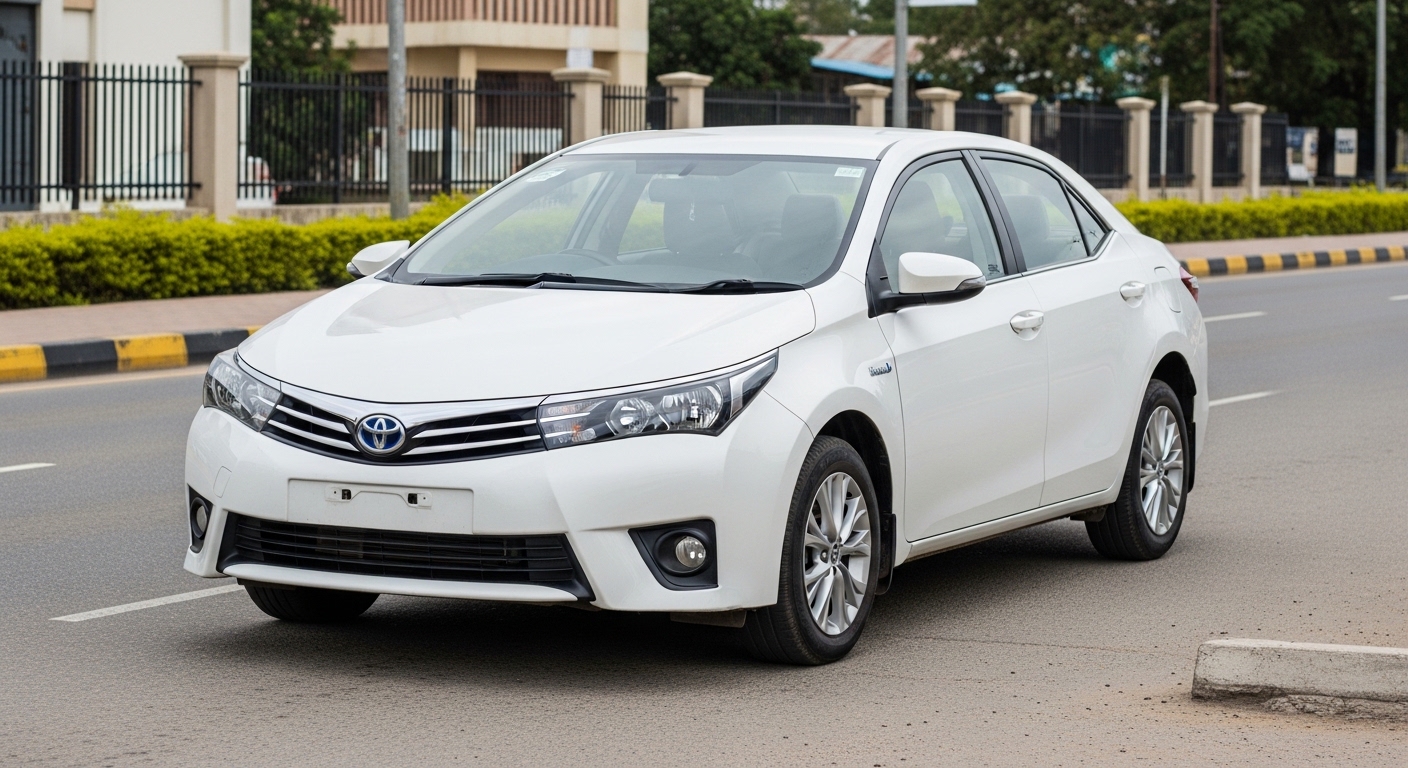 2015 TOYOTA corolla
The same page also shows why specs alone are never enough. You can see the auction sheet is available, an in-house inspection exists, and the inspection notes call out minor bumper and fender marks rather than hiding them. The detailed spec block lists 2,600 mm wheelbase, 4,400 mm length, 1,695 mm width, and 1,475 mm height, which is useful for checking the listing against its own body style and paperwork rather than assuming it matches an Axio sedan (2015 Toyota Corolla Hybrid example, 2026).
The real lesson is simple. A low odometer reading only matters when it matches the paperwork trail. A strong grade helps, but it is not a warranty. And the listed vehicle price is never the full Tanzania answer. You still need the vehicle page's estimated landed-cost panel before you decide whether the car is genuinely good value.
A live Tanzania-bound Corolla example showing 26,000 km, grade 4.5, a 1500 cc 1NZ-FXE hybrid engine, and both auction and in-house inspection evidence shows what useful transparency looks like before payment (2015 Toyota Corolla Hybrid example, 2026). Buyers should read those signals first, then judge landed cost, not the other way round.
What could the Axio cost you to run in Tanzania?
As of 5 August 2026, EWURA's Dar es Salaam petrol cap was TZS 3,898/L, and that makes Toyota's official Axio maths about TZS 140.2/km for the Hybrid EX and TZS 196.9/km for the petrol CVT EX (EWURA August cap notice, 2026; Toyota Japan Axio catalogue, 2025). So yes, the hybrid's advantage is meaningful if you actually drive enough.
That gap turns into a useful annual comparison. At 10,000 km a year, the official-economy maths comes to roughly TZS 1,402,158 for the hybrid and TZS 1,968,687 for the petrol CVT. At 15,000 km, it becomes about TZS 2,103,237 versus TZS 2,953,030. At 20,000 km, the spread grows again to about TZS 2,804,317 versus TZS 3,937,374.
[CHART: Clustered column chart - Estimated annual fuel spend in Tanzania using Dar petrol at TZS 3,898/L. 10,000 km: Hybrid EX TZS 1,402,158; Petrol CVT EX TZS 1,968,687. 15,000 km: Hybrid EX TZS 2,103,237; Petrol CVT EX TZS 2,953,030. 20,000 km: Hybrid EX TZS 2,804,317; Petrol CVT EX TZS 3,937,374. Source: EWURA August 2026 petrol cap and Toyota official Axio WLTC figures.]
At the popular 15,000 km example, the hybrid saves about TZS 849,793 a year on official figures. That is large enough to matter, especially if fuel bills already bother you. Still, treat these figures as a comparison tool, not a promise. Real traffic, A/C use, tyre condition, load, and driving style will all affect actual results.
If you mostly drive in Dar es Salaam traffic, the hybrid case usually gets stronger, not weaker. If you drive less, or you simply prefer a plain petrol automatic, the petrol CVT can still be reasonable. The point is to do the maths with your driving pattern, not someone else's.
Using EWURA's August 2026 Dar petrol cap and Toyota's official WLTC numbers, the Axio Hybrid EX works out to about TZS 140.2/km and the petrol CVT EX to about TZS 196.9/km, a yearly gap of roughly TZS 849,793 at 15,000 km (EWURA August cap notice, 2026; Toyota Japan Axio catalogue, 2025). That is why hybrid versus petrol is a real cost decision in Tanzania, not just a spec-sheet debate.
What years and specs make the most sense before import costs hurt value?
In February 2025, Toyota confirmed Corolla Axio production ended at the end of October 2025, which means every 2026 buyer is shopping the used market and import pool only (Toyota Motor Corporation production-end notice, 2025). So the smartest Axio buy is not automatically the cheapest one, it is the one where year, condition, and landed-cost logic still line up.
Older cars often look appealing because the sticker is lower. But Tanzania buying is about landed cost, not just the first figure you see. Carbarn's published import rules page makes the practical point that charges can change with CIF value, engine size, vehicle age, and vehicle type, so an older car can lose its apparent price advantage quickly (Tanzania import rules and regulations, 2026). That changes the value picture quickly.
This is where many buyers get the Axio decision wrong. They ask, "Is the car reliable?" when the sharper question is, "Does this exact year still make sense after age-related charges and condition are included?" A cheaper older Axio can still be worthwhile, but only if the inspection history is strong and the landed estimate still holds up. For a deeper age-angle breakdown, read the guide on how age changes import duty in Tanzania.
The sweet spot is usually the balance point, not the oldest car or the newest one. Aim for the year where condition, mileage, and paperwork are still convincing, while the final import-side cost stays sensible. That sounds obvious, but it is where good buys are found.
Toyota's 2025 production-end notice makes the Axio a used-stock-only decision in 2026 and beyond, while Tanzania's published duty structure means age and engine size shape the real value case just as much as the badge does (Toyota Motor Corporation production-end notice, 2025; Tanzania import rules and regulations, 2026). For buyers, the sensible target is the best year-and-condition mix, not simply the lowest advertised number.
What paperwork and inspection checks matter before you pay?
Using Carbarn's Corolla Axio specifications hub, the model family includes 1496 cc paths such as NZE161, NZE164, and NKE165, while later official Toyota data lists NRE161 at 1494 cc. That means the paperwork should convince you before the Toyota badge does.
 Car paperwork and inspection forms on a desk with pen, key fob, and dashboard trim visible
Start with identity checks. Confirm the model code, engine code, fuel type, and drivetrain all match each other. On Axio-family cars, 1496 cc does not automatically mean the same ownership experience. A 1NZ-FXE hybrid and a 1NZ-FE petrol are different decisions. Then check odometer consistency, auction grade, repair notes, underbody comments, glass condition, tyre notes, and any smell or interior damage comments.
| Check before payment |
What to confirm |
Why it matters |
| Model code |
NZE161, NRE161, NZE164, NKE165 |
Tells you the exact variant, not just "Axio" |
| Engine code |
1NZ-FXE, 2NR-FKE, 1NZ-FE |
Confirms hybrid or petrol setup |
| Auction sheet |
Grade, remarks, repair history |
Gives the first condition signal |
| In-house inspection report |
Body, interior, tyres, underbody, notes |
Adds detail the auction grade cannot show |
| Odometer |
Reading matches paperwork |
Low km is only useful when it is consistent |
| Landed-cost panel |
Estimated import-side total |
Stops you judging by sticker alone |
| Pre-shipment documents |
Inspection and CoR pathway |
Helps avoid compliance surprises |
Before you pay, make sure the documentation path is clear, not assumed. Check that the file includes the inspection documents and Certificate of Roadworthiness before export, then match those documents to the exact model code, engine code, and vehicle details shown on the listing and auction sheet.
Current Axio buying risk is usually paperwork risk more than model risk, because the family includes multiple 1496 cc variants with different codes (Corolla Axio specifications hub, 2026). In practice, that means matching the exact variant to the documents matters as much as finding a clean-looking car.
Who the Axio suits, and when to skip it
As of 5 August 2026, the Axio hybrid's official-cost maths sits near TZS 140.2/km, while the petrol CVT sits around TZS 196.9/km, and Toyota gives both the same compact 4,400 mm footprint and 461 L boot (EWURA August cap notice, 2026; Toyota Japan brochure, 2025). That means the real split is your driving pattern, not basic practicality.
| Buyer type |
Best Axio path |
Why it fits |
When to skip |
| Dar commuter |
Hybrid |
Best official efficiency, easy footprint, calm town use |
Skip if paperwork is weak |
| Budget family sedan buyer |
Newer clean petrol CVT or well-documented hybrid |
Useful boot, Toyota familiarity, simple daily use |
Skip if age surcharge kills value |
| High-mileage intercity driver |
Hybrid, if condition is strong |
Fuel savings add up quickly |
Skip if rough-road use is frequent |
If your priority is low-stress town driving, fuel restraint, and a sensible family boot, the Axio is an easy recommendation. If you want a plain automatic without hybrid hardware, the petrol CVT still deserves respect. If you need clearance, cargo flexibility, or frequent rough-road confidence, look elsewhere. A car that suits everyone suits no one.
If the Axio still looks right, start with Toyota Corolla listings in Tanzania, then read how to buy a car from Japan, and keep the Tanzania import rules and regulations page open while you compare exact vehicles. Carbarn lists Japan-based stock for Tanzania buyers, shows the auction sheet and its own inspection report before payment, includes the vehicle, shipping, and inspection in its USD price, and gives you an estimated landed-cost panel on each vehicle page so you can compare the real import picture more carefully.