


A Japanese vehicle can look affordable until you add the costs of bringing it to Tanzania. The purchase price is only one part of the calculation. CIF valuation, engine capacity, manufacture year and customs charges can all change the final amount.
A 2026 Finance Act amendment is reported to change age-based excise treatment for specified imported used-vehicle categories (Office of the Attorney General, Finance Act, 2026, 2026). The readable source text was not available during review, so do not rely on any rate here until the current TRA assessment confirms it.
This guide explains Tanzania car import duty in plain English. You’ll learn how CIF works, what TRA checks, how age-based costs affect older vehicles and how to compare the full landed cost before paying.
Quick Answer
- Tanzania car import duty is one part of the final landed cost.
- The TRA UMVVS returns CIF value, duties, taxes and fees after vehicle details are entered.
- Carbarn publishes a 25% import-duty figure based on CIF (Carbarn Tanzania, Import Rules and Regulations, 2026), but the current TRA assessment should be checked before payment.
- A 2026 amendment may affect age-based excise for specified vehicle categories; confirm the current treatment through TRA before payment.
- Do not rely on a generic percentage or old calculator. Check the current vehicle-specific assessment.
TRA assessment note: Use this article to understand the structure, not as a final customs bill. The amount can depend on the vehicle details, valuation basis, classification and rules applying at the time of clearance.
What Does Tanzania Car Import Duty Include?
Tanzania car import duty is one layer of the landed cost, not the complete amount you pay in Tanzania. The Tanzania Trade Portal says vehicle duties and taxes depend on the brand, engine size and production year (Tanzania Trade Portal, Used Motor Vehicle Import Procedure, 2026). Your final landed cost can therefore differ from the Japanese listing price.
The main cost concepts are different:
| Cost concept | Plain-English meaning | Why it matters |
|---|---|---|
| Vehicle price | The amount associated with the car itself | It is not the final Tanzania cost |
| CIF basis | Cost, insurance and freight used for valuation | It helps establish the customs basis |
| Import duty | A customs charge applied to the relevant valuation | It is one part of the tax bill |
| Excise | A charge that may depend on age, engine or classification | It can change the economics significantly |
| Landed cost | Vehicle, shipping, taxes and applicable clearance costs combined | This is the figure buyers should compare |
The practical cost path is simple:
- Start with the vehicle and shipping basis.
- Identify the CIF or TRA valuation.
- Apply the relevant import duty and excise.
- Add other applicable customs and clearance costs.
- Compare the estimated landed cost with your budget.
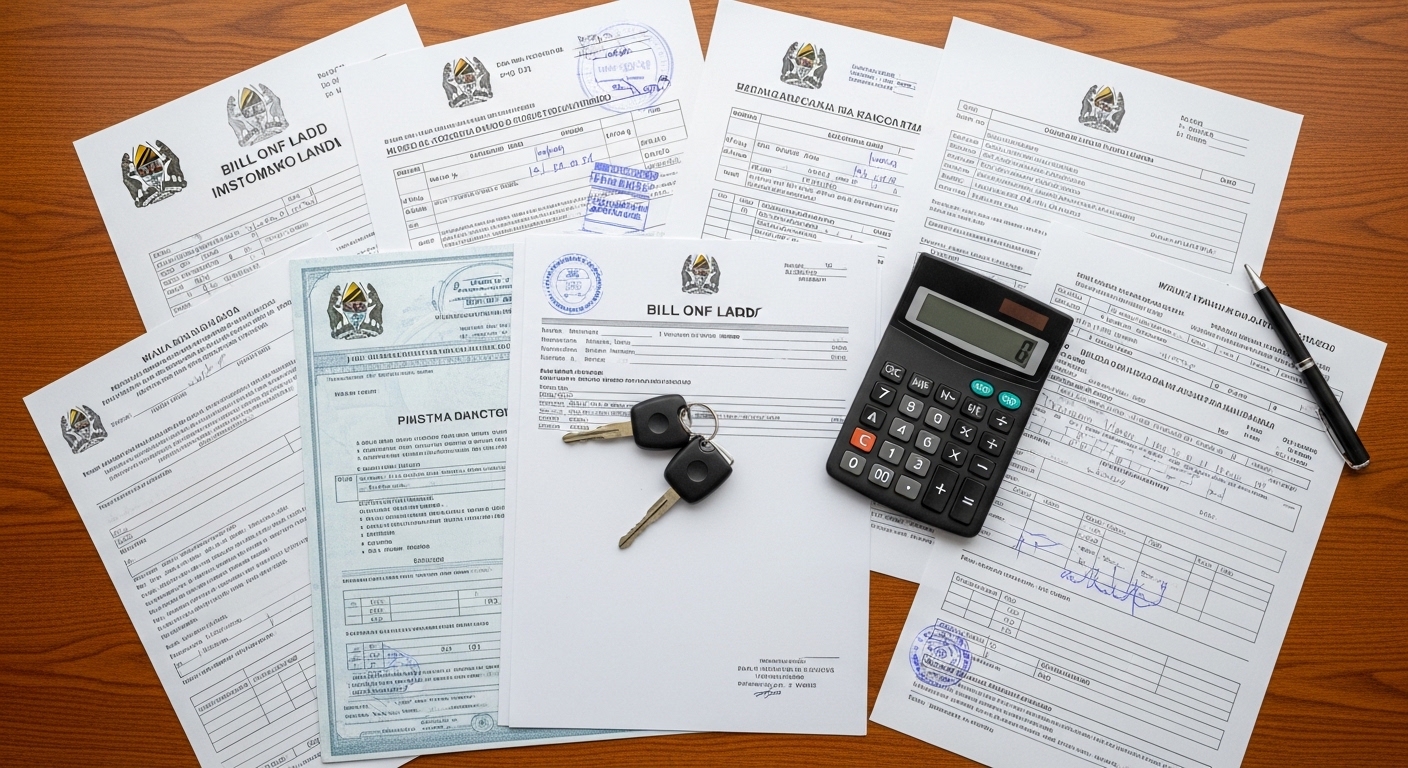
Documents, calculator, car keys, and pen arranged on a wooden desk
Import duty is only one part of the landed cost in Tanzania. The Trade Portal identifies brand, engine size and production year as important vehicle variables, while the customs valuation and other applicable charges determine the broader assessment. The Japanese purchase price therefore cannot answer the final cost question on its own. Buyers should compare the vehicle price, shipping basis, current TRA valuation, applicable taxes and clearance costs before choosing a car.
For a wider explanation of the buying stages and documents, see how the Japan-to-Dar es Salaam buying process works.
CIF When Importing a Car
CIF is the cost, insurance and freight basis used when assessing an imported vehicle, rather than the final on-road price. The TRA customer guide shows that the UMVVS returns four output categories: CIF value, duties, taxes and fees (TRA, UMVVS Customer User Guide, 2026).
Cost refers to the vehicle value used in the transaction or valuation process. Insurance covers the relevant movement risk. Freight covers transport to the destination port, such as Dar es Salaam.
| Term | Plain-English meaning | Buyer question |
|---|---|---|
| CIF | Cost, insurance and freight to Dar es Salaam | What valuation basis will be assessed? |
| TRA valuation | Assessment based on the vehicle details entered | Does the vehicle data match the entry? |
| Landed cost | Total after import and clearance layers | What will the vehicle cost in Tanzania? |
The vehicle price shown by an exporter should not automatically be treated as the full customs basis. Ask for a proforma invoice that clearly identifies the vehicle, shipping details, manufacture year and engine capacity.
For Carbarn listings, the displayed USD price covers the vehicle, shipping and inspection. Import duty, VAT and customs clearance are separate customer costs. Always check the exclusions on the current invoice and vehicle page.
CIF refers to the cost, insurance and freight basis used when estimating a vehicle’s customs value. It should not be confused with the final on-road price, because taxes, clearance and other applicable costs are added separately. A proforma invoice can help you understand the vehicle and shipping basis, but the current TRA assessment remains the important reference for customs planning.
You can review Carbarn’s published import rules and duty structure alongside the proforma invoice, but confirm that the page reflects the latest tax rules.
What 2026 TRA Tax Changes Should Buyers Check?
Buyers should treat the reported 2026 age-based excise change as a point to verify, not as a confirmed universal rate. From 1 July 2026, a Finance Act amendment is reported to change age-based excise treatment for specified imported used-vehicle categories (Office of the Attorney General, Finance Act, 2026, 2026). The source text could not be directly verified during review, so older or newer percentages should not be used as a current calculation without TRA confirmation.
The researched 2026 structure is:
| Vehicle age category | Current treatment to confirm |
|---|---|
| 8 years or less | Confirm with the current TRA assessment |
| More than 8 years but not more than 10 years | Confirm the applicable age-based excise |
| More than 10 and up to 20 years | Confirm the applicable age-based excise |
| More than 20 years | Confirm the applicable age-based excise |
These figures describe the age-based treatment identified in the Finance Act. The exact vehicle category, calculation base and final application should still be confirmed through current TRA guidance before payment.
Import duty is a separate layer. Carbarn’s published import-rules page states a 25% import-duty figure based on CIF (Carbarn Tanzania, Import Rules and Regulations, 2026). That figure can help explain the planning structure, but it should not replace the current UMVVS assessment or a final customs calculation.
Other cost categories may also apply. These can include engine-related excise, VAT, customs charges, inspection-related costs, registration and clearance costs. VAT treatment should be checked for the relevant Mainland Tanzania classification, including any applicable exemptions, rather than inferred from an outdated public page.
Older percentage figures come from historical guidance. Treat them as unverified for current buyer planning unless a current TRA assessment specifically confirms the applicable treatment.
From 1 July 2026, a Finance Act amendment is reported to change age-based excise treatment for specified imported used vehicles. Because the source text was not directly readable during review, buyers should confirm the vehicle classification and current treatment with TRA before relying on any rate. The reported amendment does not remove the need to check engine-related charges, valuation and clearance costs separately.
[UNIQUE INSIGHT] The biggest mistake is treating an age charge as a simple penalty added to the Japanese purchase price. In practice, it can change whether an older vehicle remains good value after the wider customs assessment.
How Do Engine Size and Manufacture Year Change the Cost?
Engine capacity and manufacture year affect different parts of the import assessment. The 2026 Finance Act is reported to include an excise entry under HS Code 8703.21.90 for assembled vehicles not exceeding 1,000cc (Office of the Attorney General, Finance Act, 2026, 2026). The source text was not directly readable during review, so do not publish or apply a rate until TRA confirms the classification and current treatment.
The wording matters. A treatment for assembled vehicles is not automatically a universal rate for every imported used vehicle. The current classification for an imported used vehicle should be confirmed through the TRA UMVVS and the relevant customs schedule.
Take the engine capacity from reliable vehicle records. These may include:
- Export documentation
- Auction documentation
- The vehicle’s official specification
- The proforma invoice
- The UMVVS entry
Do not estimate engine size from the model name. Two vehicles with similar names may have different engines, fuel systems or classifications.
Manufacture year creates a second cost question. It is not always the same as first registration year, so check the manufacture year in the export records and customs entry.
Check the manufacture year across the export certificate, auction sheet, proforma invoice and UMVVS entry. If one document shows a different year, pause the purchase discussion until the mismatch is explained.
A mechanic inspects a Nissan V6 engine bay in an auto workshop.
A hybrid still needs its engine capacity, age and classification checked. The same applies to a larger family vehicle. It may suit your needs, but the cost plan must reflect its details.
Engine capacity and manufacture year are separate variables. The 2026 law means the previous under-1,000cc assumption needs checking, while an older manufacture year can move a vehicle into a higher age-based excise category. Use the figures shown in the vehicle records and confirm the classification through the current UMVVS assessment.
For practical guidance, see how engine size affects Tanzania import costs.
How Do You Estimate the Landed Cost of an Imported Car?
The safest landed-cost estimate uses the exact vehicle details and the TRA valuation rather than a generic percentage. The UMVVS customer guide describes four outputs after entry, CIF value, duties, taxes and fees (TRA, UMVVS Customer User Guide, 2026).
Use this sequence before you commit:
- Confirm the exact make and model.
- Confirm the manufacture year.
- Confirm the engine capacity and fuel type.
- Confirm the vehicle classification.
- Identify the CIF or valuation basis.
- Enter the details into the TRA UMVVS.
- Review the CIF value, duties, taxes and fees shown.
- Check whether age-based excise applies.
- Add remaining clearance and applicable local costs.
- Compare the result with the vehicle-specific estimate.
A planning formula looks like this:
Estimated landed cost = vehicle and shipping basis + import duty + applicable engine excise + age-based excise where applicable + VAT and other applicable customs charges + clearance and remaining local costs
This formula explains the structure. It does not produce a final TRA bill by itself.
Consider three illustrative profiles:
| Profile | Main variables | What it demonstrates |
|---|---|---|
| Newer small hatchback | Smaller engine and newer manufacture year | May offer simpler cost planning |
| Newer mid-size family vehicle | More space and a higher vehicle basis | Shows the cost of choosing more capacity |
| Older passenger vehicle | Lower purchase price and an age category | Shows how the apparent saving can shrink |
Imagine two vehicles in a similar general USD purchase band. The first is newer with a smaller engine. The second costs less in Japan but is old enough to attract a higher age-based charge. The second vehicle may not remain cheaper after assessment.
Worked example, fictional figures only: Assume a CIF basis of $10,000. For illustration, show import duty as $2,500, applicable excise as $500, VAT as $1,000 and other customs or clearance costs as $300. The illustrative landed-cost total is therefore $14,300. These figures are not a TRA quote: the duty, excise, VAT amount and final total must come from the current vehicle-specific assessment. Check the official TRA UMVVS when it is available, and do not treat this example as a final customs bill.
[ORIGINAL DATA] The most useful comparison is not “Which vehicle has the lower Japanese price?” It is “Which vehicle leaves the smaller gap between its assessed landed cost and my budget?”
A generic formula explains the cost structure, but the safer estimate comes from entering the exact vehicle details into the TRA UMVVS. The system’s customer guide identifies four outputs, CIF value, duties, taxes and fees. Those outputs still need to be checked against the vehicle documents and any remaining clearance costs before you compare the result with your budget.
Why Is the Cheapest Car in Japan Not Always the Cheapest in Tanzania?
The cheapest Japanese vehicle is not always the cheapest option after Tanzania’s assessment. The Trade Portal identifies three vehicle variables that affect duties and taxes, brand, engine size and production year (Tanzania Trade Portal, Used Motor Vehicle Import Procedure, 2026).
This is the tax-adjusted bargain principle. Buyers should compare the full cost after checking:
- Japanese vehicle price
- CIF or TRA valuation
- Engine capacity
- Manufacture year
- Estimated landed cost
A newer smaller vehicle may suit a buyer who mostly drives in Dar es Salaam and wants more predictable budgeting. A larger vehicle may still make sense for a family, business or long-distance use, but the engine and classification need closer attention.
An older car can be tempting because its initial price looks lower. The question is whether the saving survives the applicable age-based excise. If it does not, a newer vehicle may offer better value even with a higher starting price.
| Vehicle profile | Main advantage | Main risk | What to check |
|---|---|---|---|
| Newer, smaller-engine vehicle | Potentially simpler cost planning | Less space in some cases | Engine classification and CIF |
| Newer mid-size vehicle | Balance of age and practicality | Higher purchase basis | Full landed-cost estimate |
| Larger vehicle | More space or carrying ability | Higher cost exposure | Engine and vehicle category |
| Older vehicle | Lower initial price | Age-based excise may reduce the saving | Manufacture year and current band |
What should you compare first, the vehicle price or the full landed cost? Start with the latter. The sticker price is useful for shortlisting, but it is not enough for a buying decision.
The cheapest vehicle in Japan is not always the cheapest vehicle to bring to Tanzania. Buyers should compare manufacture year, engine capacity, valuation basis and estimated landed cost together. A lower purchase price can lose its advantage when age-based excise, customs charges or other applicable costs are added.
For the next step, compare the full landed cost across suitable Japanese vehicles.
How Do You Check TRA Duty and Documents Before Buying?
The TRA UMVVS customer guide describes four main outputs, CIF value, duties, taxes and fees, after the buyer enters vehicle details (TRA, UMVVS Customer User Guide, 2026). Use the system before committing, then check that the documents match the entry.
Steps for checking the UMVVS
- Find the exact make and model.
- Enter the manufacture year.
- Enter the engine capacity.
- Enter the other requested vehicle details.
- Review the displayed CIF value.
- Review the duties, taxes and fees.
- Save the result for comparison.
- Check that the seller’s records match the entry.
- Confirm the current assessment before clearance if the rules have changed.
The result is only useful when the information is correct. A wrong manufacture year can affect the age category. A wrong engine capacity can affect the applicable excise treatment.
Third-party calculators can help with general orientation, but they may not reflect the current vehicle-specific assessment. Treat the official UMVVS as the proper starting point, not a calculator found through a general web search.
Inspection officer reviews documents next to a vehicle chassis in a port yard
Use this pre-payment checklist:
| Document or detail | What to verify |
|---|---|
| Proforma invoice | Vehicle description, price basis and exclusions |
| Manufacture year | Consistent across every record |
| Engine capacity | Matches the auction and vehicle documents |
| Auction sheet | Vehicle identity and condition details |
| Inspection report | Findings match the vehicle record |
| CIF details | Freight and valuation basis are clear |
| Shipping documents | Destination and vehicle identity |
| TRA result | Details match the vehicle being considered |
The TRA UMVVS customer guide shows that buyers enter vehicle details and receive CIF value, duties, taxes and fees. The result becomes useful only when the manufacture year, engine capacity and vehicle identity match the documents. If those details differ, pause and resolve the mismatch before using the result for budgeting.
For the wider paperwork sequence, see the Tanzania import rules and duty structure.
How Carbarn Helps You Compare the Full Cost
Carbarn’s service can help buyers compare a vehicle-specific estimate with the wider import costs. A live vehicle page can show an estimate before payment, while the process includes the Japanese auction sheet and an in-house inspection report. Published Carbarn pages give different RoRo timing estimates, ranging from 25–35 days to 40 days for Japan-to-Dar es Salaam sea transit, so confirm the current estimate before planning around it (Carbarn Tanzania, How to Buy a Japanese Car, 2026).
A practical comparison should begin with the vehicle details, not the headline price. When comparing an older vehicle with a newer one, the manufacture year and applicable assessment can matter as much as the initial USD price.
Carbarn Tanzania’s Japanese vehicle import service lists vehicles owned by the company and ships them from Japan to Dar es Salaam. Each live vehicle page includes an Estimated landed cost in Tanzania panel, where available.
The listed USD price covers the vehicle, shipping and inspection. Import duty, VAT and customs clearance are separate customer costs. The displayed estimate is a planning figure, not a final customs assessment.
The process includes:
- Auction sheet and Carbarn inspection report before payment
- CIF information on the invoice
- EAA pre-shipment inspection or certification, according to the current process pages
- Invoice, inspection documents and bill of lading in the dashboard
- Live vessel tracking through the dashboard
Customs clearance costs and the clearing-agent process are separate from Carbarn’s listed price.

White Nissan X-Trail with Japanese plate parked beside a black van
Start by browsing Japanese vehicles for Tanzania. Open an individual vehicle page and review the Estimated landed cost in Tanzania panel before comparing models. You can also read how the buying process works and view an example landed-cost panel.
Carbarn live vehicle pages provide an estimated Tanzania landed-cost breakdown. The listed vehicle, shipping and inspection price remains separate from import duty, VAT and customs clearance, which the buyer must plan for separately. The estimate helps with comparison, but it does not replace the current TRA assessment.
Before You Pay, What Should You Check?
Before paying, verify the vehicle identity, the main cost variables and the current TRA assessment. The Trade Portal identifies brand, engine size and production year, while the UMVVS guide identifies four output categories, CIF value, duties, taxes and fees (Tanzania Trade Portal, Used Motor Vehicle Import Procedure; TRA, UMVVS Customer User Guide, 2026).
Use this final sequence:
- Confirm the manufacture year, not only the registration year.
- Confirm engine capacity from the vehicle records.
- Understand the quoted valuation basis and which costs it includes.
- Check the current TRA UMVVS result.
- Separate the vehicle price from duty, taxes and clearance.
- Compare the full landed cost with your budget.
- Review the inspection and shipping documents.
- Confirm the current rules before clearance.
Tax rules and assessments can change. A clear estimate today may need checking again if the vehicle classification, law or customs treatment changes before arrival.
Read Carbarn’s published import rules and the buying process, then confirm the latest tax treatment before payment. If you are comparing a live vehicle, use its own landed-cost panel rather than relying on a general percentage.
Before paying, buyers should verify three vehicle variables, brand, engine size and production year, then review the four UMVVS outputs, CIF value, duties, taxes and fees. This sequence gives a clearer picture than the Japanese listing price alone and helps identify document mismatches before clearance.