Japan Customs trade statistics record 121,752 used cars shipped from Japan to Tanzania between January and September 2026, checked 21 November 2026. That's up 66.7% on the same nine months of 2025, when the count was 73,048. If you're weighing up a used car from Japan, you're far from alone.
One limit matters before you read on. Japan counts the cars it ships, not the cars Tanzanians register. This guide explains what the count shows, what it misses, and what to check before you buy in a market this busy.
Quick Answer
- Japan Customs counted 121,752 used cars shipped to Tanzania in Jan–Sep 2026, against 73,048 a year earlier (checked 21 Nov 2026).
- Japan records the declared destination, so some of those cars travel on to neighbouring countries.
- A busier market makes the auction sheet, grade and inspection report more important, not less.
- Import duty, VAT and clearance are paid on top of the listed price.
What does the Japan Customs figure say?
Japan Customs, part of Japan's Ministry of Finance, publishes monthly trade statistics by product code and destination. For passenger cars (HS code 8703) declared for Tanzania, the used-car count reached 121,752 in the first nine months of 2026. The same period in 2025 recorded 73,048. That's an extra 48,704 cars in one year.
| Period |
Used cars shipped from Japan to Tanzania |
Change |
| Jan–Sep 2025 |
73,048 |
|
| Jan–Sep 2026 |
121,752 |
+48,704 (+66.7%) |
Source: Japan Customs trade statistics, HS 8703, destination Tanzania, checked 21 November 2026.
"Declared destination" is the key phrase. When an exporter in Japan loads a car, they declare where it's headed, and Customs records that. It doesn't follow the car once it lands, and it doesn't talk to the Tanzania Revenue Authority (TRA) about registrations.
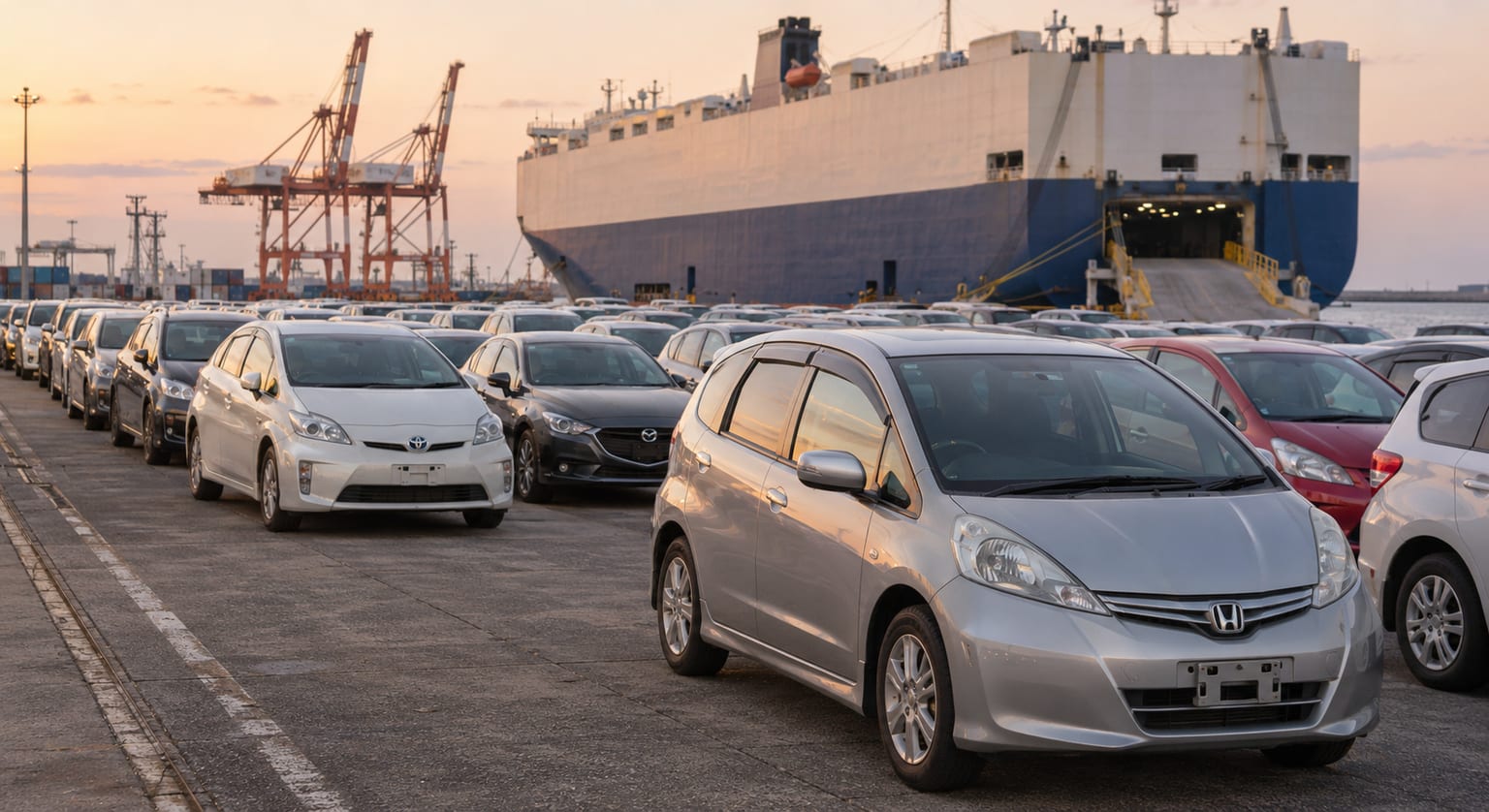 Illustration: Cars line the wharf beside a docked vehicle carrier.
Why don't all of those cars stay in Tanzania?
Dar es Salaam is a working transit port, not just a destination. Cars declared for Tanzania are unloaded there, and some are then driven or trucked on to neighbouring landlocked countries. Japan's count can't separate a car bound for Mwanza from a car bound for a border post.
No official source gives the share that moves on, so we won't guess at one. The 121,752 figure measures a busy shipping channel into Dar es Salaam. It isn't a count of new Tanzanian owners, and it isn't TRA registration data.
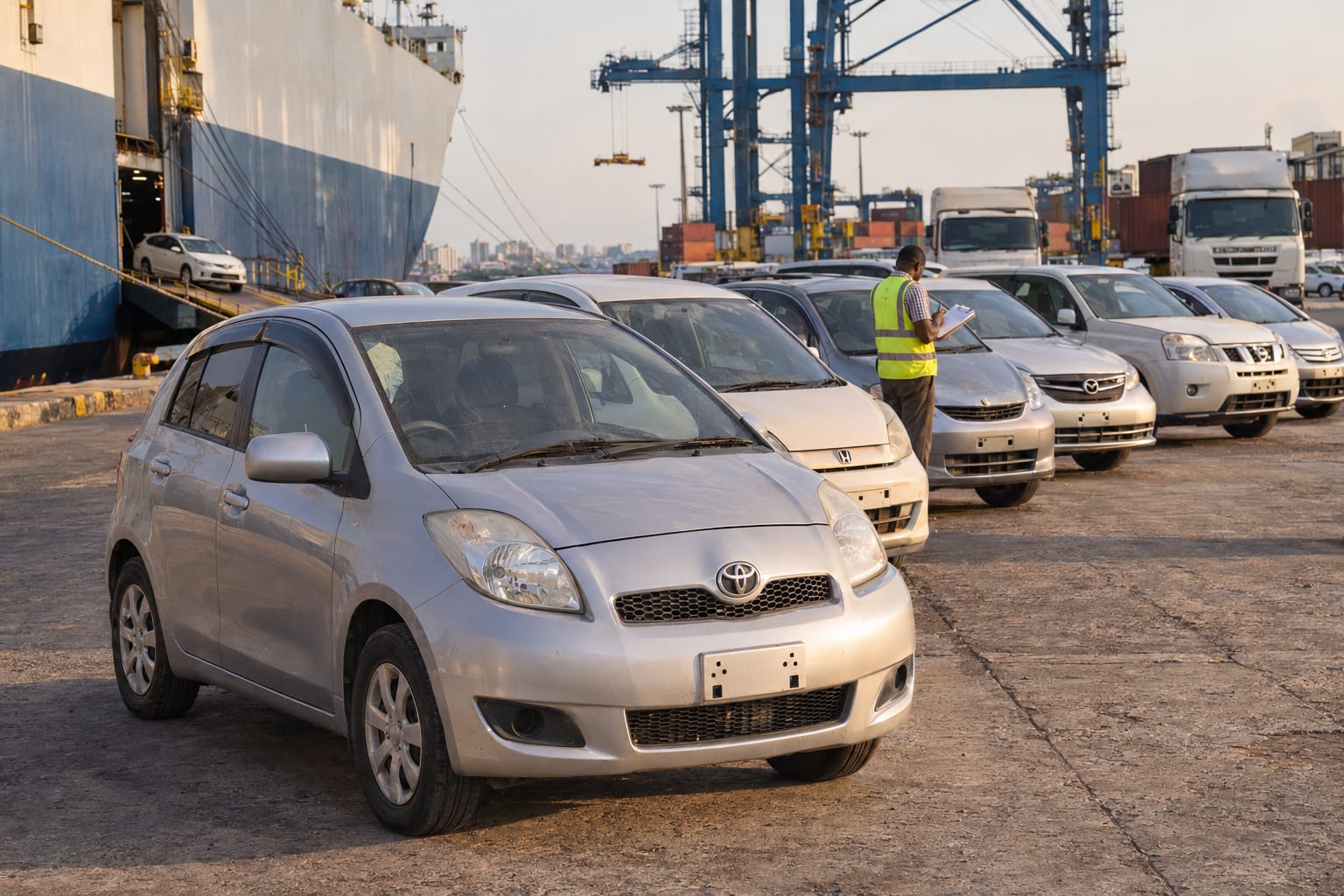 Illustration: Used cars lined up on a port quay beside a cargo ship, with a worker checking paperwork.
Why do Tanzanians keep buying from Japan?
The usual reasons for buying from Japan haven't changed. We can't prove which drove the 2026 jump, so treat these as likely drivers, not confirmed causes.
Right-hand drive fits. Tanzania drives on the left, and Japan's domestic market is right-hand drive by default, so Japanese-market cars suit Tanzanian roads.
The choice is enormous. Japan's auctions move huge numbers of cars every week.
Hybrids suit Dar es Salaam. Stop-start traffic on Morogoro Road or Nyerere Road is where a hybrid saves fuel, because the petrol engine rests while the car crawls. Japan has sold hybrids at scale for two decades, so used examples are plentiful and well understood.
What does a busy market mean for you?
A bigger market brings more choice and more competition for the popular models. A bigger pool also means a wider spread of condition, from excellent to tired. Checking each car properly separates a good buy from a bad one.
Three things matter more than the sticker price.
The auction sheet and grade. Every car sold at a Japanese auction comes with an inspector's sheet showing a grade and a damage diagram. One caution: an auction grade describes bodywork and interior. It does not prove hybrid battery health, so ask for a separate check on that.
The pre-shipment inspection. Tanzania requires a pre-shipment inspection in Japan. A car that arrives without its Certificate of Roadworthiness faces inspection at destination and a penalty. Our explainer on whether a used car from Japan needs TBS inspection covers what the inspection does and doesn't tell you.
The total cost. Import duty, VAT and clearance charges are paid separately to TRA, and they can add a large amount, so confirm them with TRA or your clearing agent before you commit.
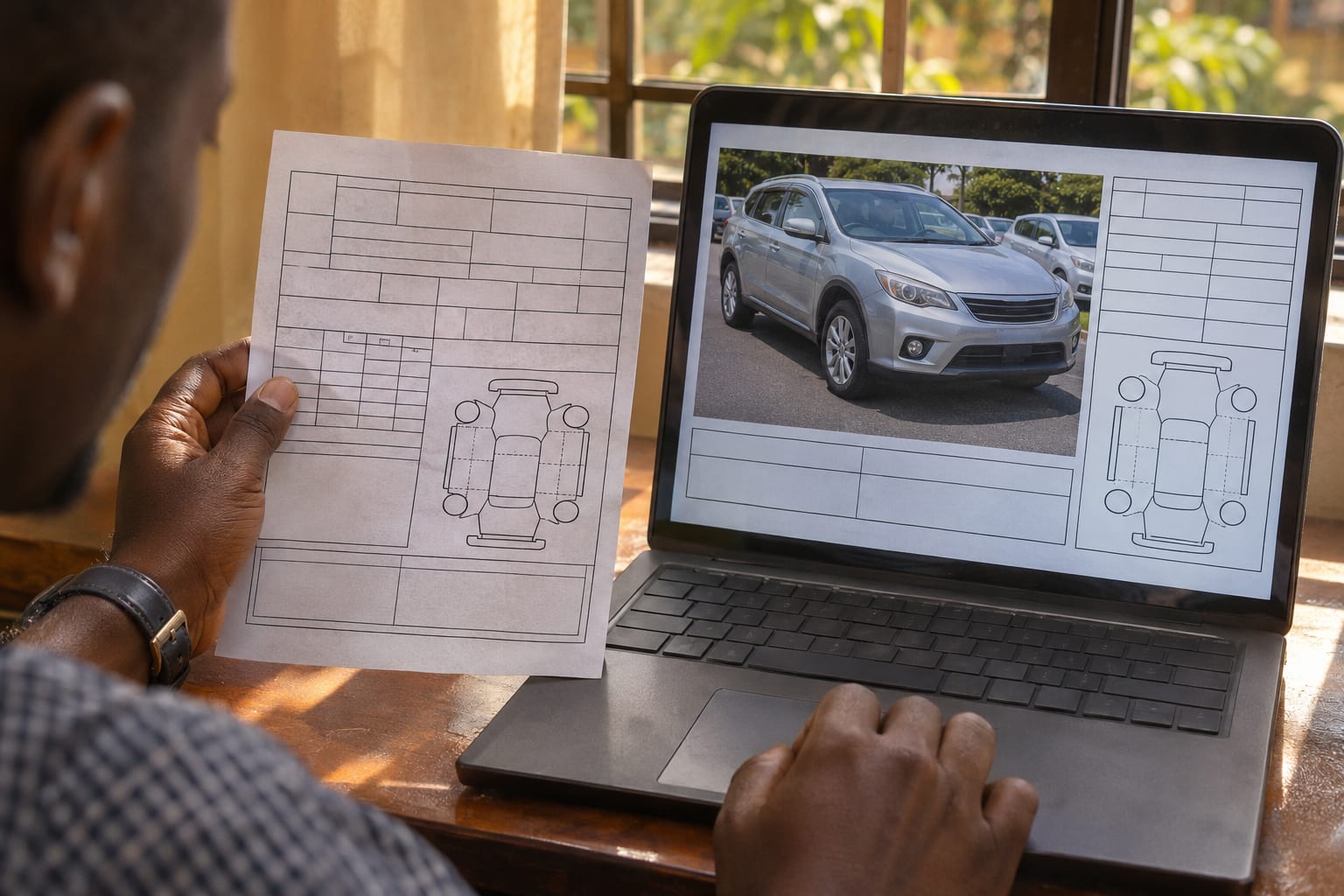 Illustration: A buyer compares a printed inspection sheet with vehicle information on a laptop.
Buying from Japan with Carbarn
Carbarn is an exporter based in Yokohama that sells used cars direct to Tanzanian buyers. Every car it lists is owned by Carbarn, so there's no broker in the middle. Before you pay, you see the official Japanese auction sheet and Carbarn's own inspector report with photos and defect notes.
The listed price is all-inclusive in USD and covers the vehicle, RoRo shipping to Dar es Salaam and the EAA pre-shipment inspection. It does not include import duty, VAT or customs clearance. You pay those to TRA, and you or your clearing agent handle clearance.
Payment is by bank transfer to Carbarn Japan, with account details provided only on the official proforma invoice, or by credit or debit card online. You get documentation to read before committing.
You can browse the full range, start with the Toyota listings if that's your shortlist, or read the five-step how to buy guide first.
What this does not show
The 121,752 figure is a count of cars declared for Tanzania when they left Japan. It is not a count of cars registered in Tanzania, and it is not TRA data. Some of those cars pass through Dar es Salaam on their way to neighbouring countries, and no official source gives that share.
The count also says nothing about the cars themselves. It doesn't record condition, auction grade, engine size or age, and it doesn't tell you what any car cost once duty, VAT and clearance were paid. For those, you still need the auction sheet, the inspection report and TRA's own assessment.
Method and sources
- Japan Customs trade statistics, HS code 8703, used passenger cars, destination Tanzania, January to September 2026 against January to September 2025. Checked 21 November 2026.